Archive | Portugal RSS feed for this section
May 2, 2011

Lisbon, Portugal Wishes You Were Here

Lisbon, Portugal Wishes You Were Here

The tram cables create a crisscrossing web over the city. Looking up to the sky, you see their haphazard pattern and it appears you are stuck here. Having heard of Lisbon’s devastation earthquake in 1755, I can see why the city needs all the protection it can get.

Apart from being a protective web, those cables serve a purpose: to effortlessly glide yellow trams up and down Lisbon’s seven hills. I hop on Tram 28, the historic route packed with tourists and pickpockets. The driver of my cutesy tram is not the cutest of drivers. He steers the tram through Lisbon as though he is out for revenge, confused if his profession is tram driver or rollercoaster controller. Speeding up, slowing down, my head dangles out of the window as I view the sights of Lisbon from a rollercoaster ride.

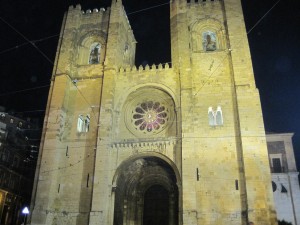
We pass by the Cathedral. Lisbon’s Sé glows remarkably at night. Those tram cables obstruct all shots, but without them, I’m not sure the image would be so alluring. A little rough around the edges, the cathedral has withstood the test of earthquakes in Lisbon’s history. Constructed in the 1150s, you wouldn’t know it had been battered and bruised here and there.

The tram “ride” takes me to Castelo de Sao Jorge, the city’s castle up high on a hill. Somewhat ruined, the views are not. You can see most of the city from the castle that changed hands from the Visigoths, Moors and Christians.

As I step off the whirlwind ride, I pause to appreciate what my feet are standing on below. All around the city, you will find snaking mosaic designs. If you stare too long, you almost feel like it is an optical illusion. Black, white and people all over, Lisbon is the ultimate survivor. 60,000 people lost their lives in the Great Lisbon Earthquake on November 1, 1755. Three tsunamis, fires and aftershocks destroyed Lisbon almost completely. One local wrote after the earthquake, “That was the year when Lisbon town saw the earth open and gulp her down.”

I look out to the Atlantic and ponder what Lisbon could have been if it weren’t for Mother Nature. However, I am brought back to now and Lisbon sure knew how to rebuild. Unlike any other European capital, Lisbon has an air of difference I can’t quite place. Perhaps it doesn’t feel like Europe to me. In the meantime, I don’t want to leave its cluttered and protective web of tram cables.

Would you like to have your photographs featured here? Email me at suzy@suzyguese.com.

April 22, 2011

The Churches in Europe Wish You Were Here
The Churches in Europe Wish You Were Here

With Easter Sunday just days away, I am reminded of all of the houses of worship I have seen. In Europe, one church after another starts to blend together, especially if you are on some whirlwind tour. Regardless, these spaces evoke a silence and calm away from the rest of the world. Even if you aren’t a religious person, you can appreciate the architecture, history and peace that comes while sitting in a pew.

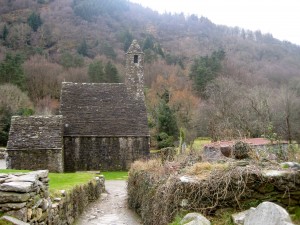
St. Kevin’s Church, Glendalough, Ireland


St. Kevin’s Church in Glendalough Ireland has that rugged appeal. The saint set up a monastic site here around 570 A.D. In the heart of the Wicklow Mountains, a mist hangs over the air, as the simple stone structure stands somewhat altered from its deep origins.

Jelling Church, Jelling, Denmark

The burial mounds and runic stones at Jelling are considered to be Denmark’s birth certificates. Housing the story of Denmark’s beginnings is the Jelling churchyard. I couldn’t enter the church for it was locked. However, I could imagine the last pagan king of Denmark converging with the first Christian king of the country on these grounds.

Capela Dos Ossos, Évora, Portugal

Perhaps the most chilling church I have entered is the Capela Dos Ossos, literally translating to the Chapel of Bones, in Évora, Portugal. Around 5,000 people make up the walls of this chapel. From one skull to the next, you can tell the differences in person. At the chapels entrance a sign reads, “our bones await yours”, spine tingling to say the least.

Fulda Cathedral, Fulda, Germany

A distant grandmother was baptized here; perhaps that is why I felt pulled in the cathedral’s direction. Then again, it could be its size. Fulda’s Cathedral dominates the town. On Sunday mornings, little old ladies scramble to get inside before the bells cease their chimes. The tomb of Saint Boniface also lies within the Cathedral.

Duomo di Santa Lucia, Ortigia, Sicily

The Duomo in Ortigia is by far my favorite church in Europe that I have seen. Along its sides you can see the columns to the Greek temple to Athena. The grand architecture is a symbol of changing of faith, going from the belief in several higher powers to just one with its baroque façade. It faces a blindingly white square as it tells just what religion can be throughout time. The faiths may change but the structures are still the same.

Do you have a favorite church, mosque or temple from your travels?

Would you like to have your photographs featured here? Email me at suzy@suzyguese.com.

February 24, 2011

Exploring Travel and Home in Sagres, Portugal
Exploring Travel and Home in Sagres, Portugal

The Romans referred to Sagres, Portugal as the Promontorium Sacrum, the end of the world. Sagres upholds that world’s end attitude as you stand on the cliffs of Cabo de Sao Vicente in Portugal’s Algarve region, the most southwesterly point in Europe.

With connections to Portugal’s rich nautical past, this section of Portugal lends the closest form to understanding travel and home in one for me. Prince Henry the Navigator supposedly built a fortified town here along with a school of navigation. He was also thought to have a home here and to have died in Sagres in 1460.

Whether it is fact or fiction, little remains of Sagres’ historical value. The nearby cliffs of Cabo de Sao Vicente even tell a story. Supposedly the relics of Saint Vincent were carried to the Cape from the Holy Lands by ravens, until they were ultimately carried on to Lisbon where they remain. Saints and explorers contribute to the feeling here of the world’s end, the mingling of the holy and curious of mind.

Once supposedly infested with explorers focused on learning how to travel and how to find new lands, I gaze down at these cliffs. You can see where many of those famous Portuguese explorers parted with their home. The cliffs dip down into the sapphire blue ocean. No signs of home remain. Just a constant shade of blue these explorers hoped to meet at some point with land.

Should these Portuguese explorers return, they would be coming home. Portugal was all they knew until setting sail for far off lands. What made travel so intriguing back in the day was the promise of the new and different, of wealth and resources. Say some lucky duck would strike gold in a new land, they would bring back the riches to their home.

Traveling away from home is an enriching experience, even if you don’t find that pot of gold over the rainbow. I think travelers often forget their homes, selling off their lives back home to travel. While I fully respect those travelers, I do believe there is some benefit in coming home every once in awhile. Like those explorers coming home to share in the riches of their travels, travelers can do the same. Altering notions back home of the rest of the world can be more powerful than never coming back to it or never having a home.

Perhaps you create home in another part of the world and are suddenly one who says they are not from anywhere, those who don’t have a home. Maybe you only travel a few weeks out of the year and come back to a familiar base each time. No matter the extreme, we begin travel education in one place, just as these explorers did, studying maps and routes, figuring out the path of least resistance and dreaming up those grand plans for travel.

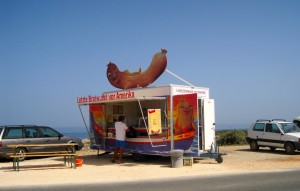
Sagres and its cliffs remind me of this, that without my starting point of home, without the spark of travel learning, we could not leave anywhere. We become so focused on how to rid ourselves of home, we forget to thank it. You need a home at some point in order to travel. Years of never coming home shouldn’t let us forget where our travels all began. At the cliffs of Cabo Sao Vicente, you may see a stand that reads “The last hotdog until America” in German. Even a hotdog stand knows where it came from and where it has been.

Do you think travel is possible without a home?

October 19, 2010

Porto’s Leaps and Bounds

Porto’s Leaps and Bounds

The table across from me holds three characters. A woman clad in an off the shoulder turquoise top fans herself as her face seems to glisten. The woman seated next to her reads a magazine with black-rimmed glasses on the very tip of her nose. The man at the table appears relaxed, transfixed on the woman in turquoise. Then, another colorful character enters the picture, a woman dressed in gathered leather pants. Probably well into her sixties, she dances to the “cha cha” truly as if no one is watching her. This group sits and dances to my diagonal right in a loud bar in Porto. Potentially the youngest person here, I get my first taste of Porto, Portugal.

Waiters adorned in cheap tuxes and skewed hair serve steak and fish dishes. A band plays by the bar to all up-tempo songs. An older crowd turns toward the music as a few, like Miss Leather pants, get up and dance. Most are couples twirling about, appreciating a Friday night in Porto. To say Porto was colorful, from its characters to its buildings, would in fact be a Portuguese understatement.

Not having too much time to spend with the city the next morning, wandering became key toward understanding Porto. The northern Portuguese city sits at the mouth of the Rio Douro. With claims of being Henry the Navigator’s birthplace, Porto’s history is tacked up on every tiled walled.

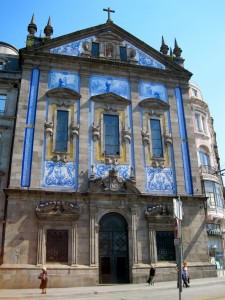
Strolling through Porto, you are bound to encounter that tile work. On the facades of churches, light blues and whites add an element to the city I couldn’t quite place. Addresses to homes are laid in tile work, with some hosting more creative names.

To see Porto from above, the Clerigos Tower makes you work for it. Completed in 1763, the tower was used by ships as a guide into Porto. Baroque and designed by Italian architect Nasoni, climbing to the top, some 240 steps and 76 meters up, once again, the tile work of Porto becomes apparent.

Heading down toward the Ribeira district, the UNESCO listed and approved section of the city by the water, Ponte de Dom Luís I connects Porto and its Gladys Kravitz of a neighbor, Vila Nova de Gaia. So close to Porto, you may confuse the two areas for being one city. On a hot summer day, the preteens of Porto find comfort in putting on a show for all of the tourists. One by one they jump off of Ponte de Dom Luís I, the work of a student of Gustave Eiffel. The elderly of Porto don’t find this scene so amusing as an old man stands on the bridge shaking his head, personifying Porto’s struggle of the old and the new.

The courage of those preteens embodied Porto for me. The city crumbles and decays in areas throughout, as Lisbon tends to steal most of the big city attention in the country. However, Porto continues to make subtle leaps and bounds to grab you in, whether it is the characters in a bar dancing beyond years on a Friday night, the loud titles surprising you with the turn of a church corner or those 14 year olds down by the Douro, using the river as their source of good, old fashioned fun.

September 28, 2010

Medieval Soiree In Silves, Portugal

Medieval Soiree In Silves, Portugal

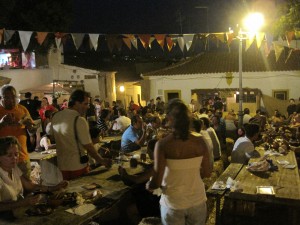
Prickly straw pokes my bare skin as I taste God only knows what while sipping Sangria out of a handmade ceramic mug. Little did I know, today was not the day for shorts or a weak stomach. Pushy Portuguese crowd my dinner table. Communal, crowded yet colorful, Portugal still manages to muster up medieval times in a modern world.

While in the Algarve region of Portugal, with high-rise hotels, resorts and drones of beach bums crowding every inch of sand, for me, it wasn’t time to park my pasty self on a towel and bake in the sun, but rather find the only patch of shade no one seemed to want. Post beach attempt and half a bottle of sunscreen later, the grumble of my stomach alerted dinner needed to happen. Picking a town on the map more inland, the town of Silves promised to be a quiet and cute little settlement, away from the harsh resorts of the Algarve. I pictured a quiet dinner of some Portuguese specialty, but rather I found a raging party back in time.

I discovered yet another reason I love travel, how unexpected places can be. Little did I know while working my leg muscles up to Silves that its annual medieval fair was taking place that night. Renaissance and medieval festivals are not uncommon in any part of the world. However, those in the USA tend to be hard to imagine, a country that never had a Renaissance.

Silves represented medieval times to a T. Costumes and even the vendors looked right out of the days of plague, meats, and battle. As I ordered a chocolate crepe from one stand, the woman behind wiped her brow, looking exhausted and hot in the grueling heat of the Algarve. I kept looking at her and imagining her character placed centuries ago. Throughout the festival, characters like the crepe woman presented, seemingly lost in time.

Before my crepe experience, the unexpected medieval fair called for me to be adventurous. Most restaurants appeared closed, opening up their business to classic medieval dishes. Ordering a pile of meats and vegetables, I didn’t want to know what I was eating. Was it good? Not exactly, but it was part of the experience.

Travel forces you to adapt to a situation. I may have been planning a nice meal in Silves, but there is something to be said for sitting on hay bales, drinking out of middle age mugs and eating bad food, probably just as it was in medieval times. It is the pleasant surprise of stumbling upon an event without knowing of its existence that keeps travel unendingly interesting.

Have you ever stumbled upon a traditional festival or special event on your travels?

September 17, 2010

Porto, Portugal Wishes You Were Here

Porto, Portugal Wishes You Were Here

Clark and Kim from To Uncertainty and Beyond capture Porto, Portugal. I was also in Porto this summer so expect a post soon on this enchanting, can’t quite put your finger on it, city. In the mean time, enjoy Clark and Kim’s moments with Porto.

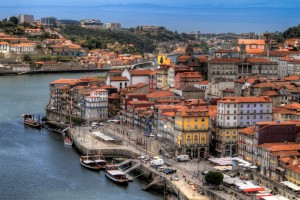
As our train pulled into Porto, we found ourselves crossing a bridge and beholding the city from the best view imaginable.  The colorful buildings piled high on the banks and the beautiful, high bridges spilling across the river make Porto truly breathtaking.

Porto is the second largest city in Portugal and is alive with activity.  Boats hurry up and down the Douro river and trains, cars, and pedestrians dash across the bridges. Our favorite experience in Porto was crossing the Luís I Bridge to tour the Port wine cellars across the river.  Not only is the bridge itself beautiful, but it affords a great view of the city from about 50 yards in the air.  There are people shopping, dining, fishing, singing, and working at every turn.  You can get lost in the winding streets along the sides of the hills, but you won’t be disappointed.  There is a beautiful building or crumbling road at every turn.

For more from Clark and Kim, visit To Uncertainty and Beyond.

Would you like to have your photo featured here? Email me at suzy [at] suzyguese [dot] com.

August 28, 2010

Évora in the Evening

Évora in the Evening

In the Alto Alentejo region of Portugal, Évora is not an undiscovered place of beauty. The preserved medieval town has its fair share of tourists passing through daily, but in the evening, the city oddly brightens, revealing its protective, historical, gruesome, spooky and friendly side all wrapped up into the confines of its Roman walls.

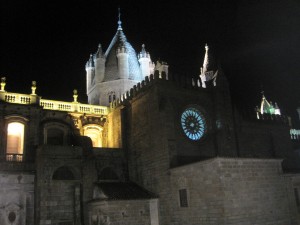
Évora’s Sé looks more like it is ready for battle than attune to prayers of sinners and saints. Massive, monstrous and topped with varying domes in size, shape and color, the Cathedral holds much of the city’s richest history. Construction began on the Sé in 1186. Explorer Vasco da Gama had his ship’s flags blessed here, perhaps preparing not in a heavenly sense for a long and hopeful journey, but rather ready to battle the unknown with the help of a fortress cathedral back home.

Strangely, a lone Roman temple lies just before Évora’s Cathedral. Templo Romano stands in 2nd century origins, well preserved as it was walled up in the Middle Ages. The Corinthian columns take in the heat of Évora’s sun, eager for early evening when bouts of shade parasol Portugal’s intense summer heat.

The center of the city lies in Praca do Giraldo. Pleasant cafes and their tourist menus dress in locals and visitors sipping on a cool drink before dinner. The scene is all too idyllic until research tells you Praca do Giraldo was not always so pleasant. Victims of the Spanish Inquisition were burned publicly in the 16th century in Praca do Giraldo. Agrarian reform squabbled in debate from throughout the space in the 1970s. Today, it is hard to imagine with all of Évora meeting up here to share stories from the day.

Perhaps Évora’s most chilling site resides in Capela Dos Ossos, literally the Chapel of Bones. Skulls and bones from 5,000 people make for a spine tingling wall treatment. Faces can be differentiated from one skull to the next, noting one personality from another. Built in the 17th century as a reminder of death and a meditation on the human condition, entering the Capela Dos Ossos, visitors must stop and read an even more disturbing sign stating, “Our bones await yours.”

Wandering through Évora’s streets, white homes outline their windows and doors in mustard yellow. Street lamps guide to cozy cafes. Sitting down to an evening meal lends dinner guests you might not expect. Even the stray dogs of Évora are pleasant in the evening. One black beauty lays down next to me as I munch on tortilla chips and lackluster salsa. He doesn’t want food. He just wants company, going from table to table and eavesdropping on nightly conversations.