Archive | Take Me Away To… RSS feed for this section
April 6, 2012

Jackson Square in New Orleans Wishes You Were Here

It was on Good Friday in 1788 that the bells of St. Louis Cathedral in New Orleans went silent. The silence of the bells for the holy day inadvertently failed to alarm the city of a raging fire that would destroy much of New Orleans, the cathedral included. This would not be the beginning or end of the cathedral’s troubles, but like most aspects to New Orleans, there is an insatiable spirit to move on, fires, hurricanes and all.


St. Louis Cathedral sets up in Jackson Square, the center of the original settlement of New Orleans. It boasts of being the oldest continuously active Catholic cathedral in the United States. While its front receives plenty of attention by day, it is its back that lights up with attention at night. A statue to Jesus stands with arms stretched to the heavens. A light casts on the big man to create a shadow rivaling all those in New Orleans.


Once the shadow of Jesus fades into the daylight, artists, fortunetellers and street performers all come out to Jackson Square. You can hear your future in this space and then head out to the nearest bar should your fate not sound too pleasing. Originally known in the 18th century as Place d’Armes by the French and Plaza d’ Armas by the Spanish, the heart of New Orleans was redesigned and renamed after the Battle of New Orleans.


An iron fence, formal walkways and benches were added, along with the Jackson monument at its center. The bronze statue to the hero of the Battle of New Orleans, Andrew Jackson, was unveiled in this space in 1856. Inscribed on its foundations, “The Union must and shall be preserved,” again echoes the undying spirit of the city.


A few flowers suggest spring has arrived to New Orleans. A bride and groom take pictures in the idyllic space, hinting at spring’s very basis, new beginnings. It is appropriate after all for this was New Orleans’ start.


Diagonal to the square is a different scene of beginnings, one where many tourists receive their first tastes of New Orleans’ sweetness. Café du Monde, world famous for its beignets and café au lait showers in a dusting of powdered sugar. I snag a table with a view of my three beignets and of course, Jackson Square. Powdered sugar falls all over as I take my first bite, again another detail to the city you can’t recreate anywhere else.


New Orleans is all about the details. It would take a lifetime to see them all, including those in its very heart. Jackson Square sketches, tells of futures, entertains and provides subtle moments of peace. It is the beginning of New Orleans in many respects. It is the start of all of the city’s powerful particulars that make New Orleans unlike any other city in the world.

Have you been to Jackson Square in New Orleans?

April 4, 2012

A Hurricane and Hope in the Lower 9th Ward of New Orleans

The French Quarter is just three miles away from where I stand and yet, I feel like I’m in a different world. There is a sobering photograph in front of me: a picture after Hurricane Katrina and a little arrow pointing out, “You are here”. Back in August of 2005 if I had been standing under the arrow’s point, I would have been completely submerged in water and debris. A man mows an empty patch of property nearby, one where you can see the foundations of a house, the place a family used to call home.


I am in New Orleans’ Lower 9th Ward, an area of the city that was hit the hardest by Hurricane Katrina. Over 4,000 homes were destroyed by the hurricane due in large part to a faulty levee breached by the storm’s waters. Over one thousand lives were lost in it all, a great tragedy I can only very superficially try to relate. Half of the people who died in Hurricane Katrina in Louisiana were from this very neighborhood. 

I’m not here to gawk. I had heard about Brad Pitt’s Make It Right organization and their work in the Lower 9th Ward. While there are many other organizations helping rebuild New Orleans to this day, I wanted to see for myself the unique architecture and design of the Make It Right homes, built for those who so desperately needed them. Two years after Katrina, Brad Pitt was in disbelief that these families, friends and neighbors in the Lower 9th Ward were still living in disarray. It appeared their own country forgot them entirely and their lives were swept away with the memory of one of the worst hurricanes in U.S history. 

Pitt set out to build 150 green, affordable and storm resistant homes for the families who lost it all in the hurricane. As I approach the area, I can see the shine of solar panels on many homes with very unusual designs. As I get closer, I admire where lives were fortunately not forgotten. While not the New Orleans you think of when a tourist visits the French Quarter, the architecture is strangely fitting in the city.


Pitt called on countless award winning architects to construct these homes for his Make It Right organization. The idea is to make it right the first time, to build homes that can weather the storm, homes that can save residents money and in the end, lend them better lives.


I wander from block to block in the very neighborhood of Fats Domino and one of the first schools in America to be desegregated. While the new buildings, the work of those who stopped to care about these people, provide such beacons of hope, it is the ruined homes I can’t wipe from memory.


I keep thinking about my own home, where I was raised, where I grew up. If a shoddy levee broke right in front of my front lawn and a hurricane of colossal proportions ripped through my neighborhood, I wonder what would remain. I wonder if anyone would help, my own country included.

I love so many things about travel, but there are also days where I shudder uncontrollably. I feel sick at what I am observing and yet at the same time hopeful for the glimmers of change. I am angry that my own neighbors in the Lower 9th Ward have either had to leave their homes for good, or wait for someone to notice their mess, 7 years after the storm.

The U.S. pours an obscene amount of money overseas, as we try to police the world. We spend and we spend. I am angered today that we have forgotten these people in our very backyard of the Lower 9th Ward. Luckily there are some like Pitt in positions of power, influence and wealth that do, as they should. They extend an arm of help when one’s own country will not.

I came to the Lower 9th Ward to hopefully, in some small way, make a difference, to show those who just head to the French Quarter of the city and think it all must be fine and well here that it is not. Our country doesn’t appear to be taking care of their own. It is left up to individuals to help our country pick up the pieces of natural disasters and levees that should be built right the first time. I also came to the neighborhood to see the hope of help, of beaming faces from porches built to last. I notice a family on their green dream of a porch, clearly happy to be alive and have a roof over their heads. They might also be beaming for they have seen Brad Pitt in person.

I make my way out for dinner on the edge of the French Quarter. A tourist and a local have an exchange while waiting for an open table. The tourist asks the woman if she was affected by the hurricane. She says she is from the Lower 9th Ward, lost her home and simply had to rebuild, slowly and surely. Luckily for exchanges like these, perhaps someone will notice, volunteer, donate and in the process help those who are forgotten with the next passing storm.

For more about Make It Right and how you can help, visit Make It Right online.

March 30, 2012

Memphis, Tennessee Wishes You Were Here

“You can always order more,” he says slowly, surely and calmly. Worried about having just the right amount of Memphis barbecue, I was quickly assured to settle down. There is also more to be had.


The streets of Memphis seem deserted, until you round the corner to go to Charlie Vergos’ Rendezvous. Turn down into the unsuspecting alley and a whole crowd is waiting to sink their teeth into Rendezvous’ famous charcoal-broiled pork ribs. I am no different as I grab a seat at the bar upstairs to wait with the masses for a table. It all began in 1948 when Charlie Vergos decided to convert his diner’s basement into some of the city’s best barbecue with the miraculous discovery of a coal chute. Presidents and the King himself have all dined below Memphis for the ribs and Greek hospitality in the Deep South.


“Buffalo or Ram?”, the bartender says with the most stern of faces as he examines my I.D. He is referring to college football and testing if I am really 21 and from Colorado. I say neither. Clearly he isn’t in touch with Colorado football. Being in the South, it is mostly college football country, but in Colorado, the majority of people care only about the Broncos. He hands me back my I.D., forever suspicious of my intentions.


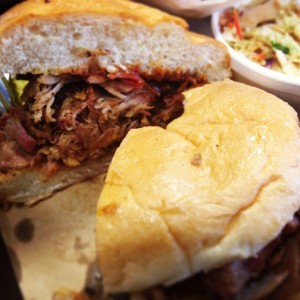
Finally my name is called. I’m not a buffalo, ram or bronco. I can only think about one animal. I order up Rendezvous’ famous charcoal broiled pork ribs. With its dry rub seasoning, I realize the best barbecue does not need a sauce. Coupled with beans and slaw, when in Memphis, even if you must face intense questioning to get your pork and beer, you must order up some barbecue.


With a bursting stomach, I take to the streets of Memphis to walk off some of those ribs now clinging to my stomach. I don’t walk long once I find the city’s old streetcars. Memphis has three streetcar routes that go by way of authentic vintage trolley cars. Harking back to Memphis’ past, you can take the Main Street Trolley, the Madison Avenue Route or the Riverfront Loop for a different taste of the city besides barbecue. Adorning bright pinks and purples and more subdued greens, the rickety cars can be heard long before they arrive.


I take the Riverfront Loop, a 2.5 mile long circle with views of the Mississippi River for the heft price of just $1. I mostly take in the views from within the old timey streetcar. Even after the car has made its loop, I notice most of the riders are just along for the ride. They don’t have a destination. Their destination is a wooden seat on the streetcar.


I quickly discover all of Memphis is either within Rendezvous or on Beale Street, the city’s equivalent to Bourbon Street in New Orleans. Police keep watch on the debauchery and even serve as photographer to a couple or two.


The next morning, I realize I don’t have time to visit Elvis Presley’s Graceland, his over the top mansion. Leaving the tour for another time in Memphis, I do have the time to wander through the National Civil Rights Museum. Set up in the Lorraine Motel, the museum details the struggle for African American freedom. The museum can be found in the motel for it was on the balcony of room 306 that Martin Luther King Jr. was assassinated on April 4, 1968.


The 1950s exterior is still in tact, along with two cars of the era. Within the museum, you can see two of the rooms preserved to look as they did when Martin Luther King Jr. checked in to 306. I pause within that very room and you can sense a presence, a struggle. Unfinished business is in the air, the business of equality and freedom.


Memphis falls right on the border with Tennessee and Arkansas. Its history has been long linked with the penning of blues, the recording the first bars of Elvis Presley and barbecued pork. It has also been a place of change, of strife and pilgrimage. You can feel the past, present and future of Memphis, mostly from the drooping wooden paneled window of an antique streetcar.


Have you been to Memphis?

March 28, 2012

An Oddball in Search of Oddities on the Road to New Orleans

Stevie Nicks belts out “Dreams” countless times on the radio during my long drive down to New Orleans. It is a song, like most I gather, about wronged love, dreams foiled and hope at the end of the storm. One line sticks with me most, “Like a heartbeat drives you mad in the stillness of remembering what you had and what you lost.” I don’t feel my heartstrings tugging over a wronged relationship, but rather my heart beats for the road. It drives me almost mad as I search for reasons to be on the road, the zaniest of roadside attractions. These roads come into my travels, I have them for a time and I quickly lose them in the rearview mirror. And still, I prefer to travel by car, heartbreak and all. When New Orleans can be within a two-day road trip, I will gladly get up early to hit the road.

I begin in Arkansas. Coming from Colorado, where as my Dad bluntly put it, “Only the dumb trees start flowering in March”, it was a vision to see brightly colored flowering trees along the side of the road. These stunners are southerners. A March frost isn’t a part of their reality as it is in Colorado. There reality consists of being pretty in fuchsia for all those behind car windows to see.


In case you don’t know my traveling style very well, I tend to seek out oddball attractions. I’m not sure what that says about me, but I will search through the corners of the Internet on my phone for just the mere chance the next town I’m passing through has the “world’s largest” of something. Watermelon, beer can, easel, I don’t discriminate their meanings. The road down from Arkansas to Louisiana presents an odd opportunity this oddball couldn’t resist, standing in two states at the same time.


I tack on 15 extra minutes to my otherwise long drive to see and do these zany things. In Texarkana, the city’s attraction is its very location. Set in Texas and Arkansas with a great State Line Avenue dividing the two, I see an end to riding the line in sight. I spot Texarkana’s Courthouse and Post Office, right on the state line. Supposedly this is the only building the U.S. to do so, fraught with indecision as to where it wants to reside, Texas or Arkansas? Standing in two different places at once sends a thrill through this road tripper. While I have no reason to be in Texarkana, its very positioning lends the city and myself a purpose. And they say you can’t be in two places at the same time.


After touching my toes in Texas, I make the long drive back of mere seconds to Arkansas. The next oddity on the road isn’t far away in the town of Fouke. The southwestern town is home to the legend of the Boggy Creek Monster, a southern Sasquatch of sorts. In the 1960s and 1970s, people began reporting a monster of around 7 to 10 feet tall roaming and harassing the area. A low budget movie even tackled the myth or mystery.


Finding the Boggy Creek Monster was much easier than I had thought. No, he wasn’t lurking in the creek or spooking some farm animals. He stands in giant wooden cutout form for people like me. I put my best monster face forward and quickly realize I couldn’t pull off Boggy Creek Monster brunette.


Crossing into Louisiana, a pelican welcomes me on the state sign. The landscape turns more swampy, making it seem entirely possible that a Boggy Creek Monster could very well cross the state line for swampland. Rather, I just catch second glimpses of what I think are gators in the water surrounding the road. Perhaps they enjoy going by road too.


Before you reach New Orleans, you might come by way of Baton Rouge. I detour yet again, tacking on those extra fifteen minutes to my long drive. I have to cast my eyes on the building in the city commanding all attentions with its size. The Baton Rouge Capitol Building is an Art Deco confection, attempting to touch the sky with its 34 stories. Manicured acreage hugs the capitol building, lending a fine place to stretch the legs.


While the evidence is undeniable that I can’t resist stopping to stand in two states, a meeting with a monster, spotting a gator, gazing all the way up a capitol to the sky or the fuchsia flowers on a blooming tree along the road, these oddities add up to a thing of normalcy for me. Traveling by car takes me back to the first moments I learned what travel was all about. I might be less annoying to travel with than I was at four years old, but I am still ever spirited when I hit the road.

New Orleans is waiting, a city that doesn’t seem to wait for anyone.  Crowds convene in the city especially this time of year, when spring break and Bourbon Street collide. It is the destination for many, but for me, it is the beginning. I almost forget where I am going amidst the monsters and wacky roadside stops. The road to the attraction is a sight for these eyes.

Do you love road trips? Have you ever forgotten about your destination and found yourself wrapped up in the journey on the road?

March 23, 2012

Scottsdale, Arizona Wishes You Were Here

The saunters of the world convene in Scottsdale for the weekend. These saunters adorn mostly baseball gear, looking to kill time in between spring training games with perhaps a little turquoise jewelry or a pony ride. The atmosphere is decidedly carnival on this stretch, but little hints of kitsch are acceptable in small doses, including this character. Old Town Scottsdale welcomes you, lasso and all.


Amidst all of the jewelry shops and art galleries is a suburb of Phoenix in the middle of the Sonoran Desert. With Phoenix to the west and the McDowell Mountains to the east, this town in the Valley of the Sun has few skyscrapers of the New York variety. It’s cactus country afterall.


At the same time, Scottsdale is not some desolate desert community. It is a time machine in some respects. I step inside the Hotel Valley Ho after getting a sweet whiff of its many orange trees outside. Not a guest of the hotel, I act as if I am as I wander through this mid century community within the desert community.

Inside the Valley Ho Photo By Charlie Guese

In the 1950s and 1960s, Scottsdale lent travelers the recreation and relaxation they were looking for in what once was truly the middle of nowhere. Built in 1956, the hotel would attract many a celebrity looking to dodge the paparazzi, including playing host to Robert Wagner and Natalie Wood’s wedding. Falling into disrepair by the 1970s, the hotel would return to its form glory in 2005. I grab dessert in the desert, selecting from a menu of appropriate retro favorites like hot fudge sundaes and banana splits.


A walk through the lobby and Zu-Zu restaurant at the Valley Ho is a trip back 50 or 60 years. The only indicator that you aren’t in 1956 is yourself. I head for the roof to survey Scottsdale’s time machine from above. The glow of the pool’s chlorine, coupled with the moonlight hypnotizes the mind yet again. Stadium lights in the distance suggest Scottsdale’s present purpose for many travelers.


Baseball is the game in Scottsdale in March, when several major league teams come down to the desert to hone their skills and hopefully make the big leagues in the process.


Closing out my weekend in Scottsdale, I pass by the Saguaro Hotel, an assault of bright colors and more retro design. You can hear the chatter of young voices, a little under the influence, screeching every so often in between the lapping sounds of pool water making waves. Right out of a mid century spring break movie like Where the Boys Are or Palm Springs Weekend, Scottsdale is the spring break destination for those saunters and baseball fans. A little heat, a little desert, a little baseball and a little bit of time travel is possible in Scottsdale.

March 21, 2012

Four Days and Four Nights in Vienna

I wasn’t supposed to be in Vienna and yet I think I was. A city I only briefly visited in college with a school group, from that first meeting, I knew I wanted more. On my recent trip through Eastern Europe, the plan was to head to Romania. However with sub zero temperatures, national road closures and snow, I decided to forgo being a world news story and find the story instead in Vienna.

Vienna is utterly effortless. It is a city so grand, so royal, and at the same time, it is unpretentious and kind. For a big city, Vienna is unhurried, appreciated with ever bite of schnitzel and Sacher Torte. We all might not fit in here, but easily for a weekend, you can find a place its Hapsburg grandeur and candy colored buildings. I savored four days and four nights with Vienna, where I spent most of my time on my two week European romp. While not enough time, four days and four nights allowed me to find the many reasons why I love Vienna. Fitting them all into a corner of the Internet would be a challenge so here are just a few ways to spend those precious 96 hours.

The Museums


An ideal city for the cold, when the weather outside is frightful in Vienna, the museums are inviting. Having visited several on my first trip through the city, I decided to visit one I have long passed over, the Albertina. Named for the son in law of Maria Theresa, the museum details artwork from the 14th century onward. Works by Cézanne, Klimt and Picasso adorn the walls, part of the 60,000 drawings and one million prints collection.


Not just a museum, in Vienna, you are never far from the Hapsburgs. Part of the former Hapsburg residence, I explore the state apartments, said to be fine examples of classical architecture. From all of the crystal, raspberry pink and mustard yellow, just for a moment in this classical palace I can picture myself a Hapsburg, just hanging out in old blue jeans in a room dripping in opulence.

The Underground

Vienna knows its regality can’t last beyond death, but the Hapsburgs thought differently. Just beyond the Albertina, lurking below the city is Kaisergruft. The Imperial Burial Vault lies below the Church of the Capuchin Friars. Began by Empress Anna and her husband Emperor Matthias, all but three of the Hapsburg dynasty members have met their end here.


Some of the tombs come simple and unadorned while the bigger players in Austrian history take on all the opulence, so similar to Vienna’s true exterior. The enormous 18th century double sarcophagus of Maria Theresa and Franz I, parents to Marie Antoinette, receives a facelift of restoration as I walk by. Among the 12 emperors and 17 empresses to be buried in the Kaisergruft, not a single heart remains. The spooky space does lend a heartless tone, filled with mere bodies, but the most famous souls of Austrian royalty.


The Coffeehouses

My best cup of coffee on my Eastern European trip came from Vienna. No wonder I love the city so. Anyone on a caffeine-high is sure to feel the high of Vienna on a more jolted level. I step into Café Hawelka, a little rattled by Vienna’s tombs and in need of a different caffeinated rattle. Filled table to table, I recognize the potential for people watching in a Viennese coffeehouse.


This café has long entertained artists, writers and fixtures in Viennese society. The woman in front of me reads her newspaper with glasses perfectly perched on the tip of her nose. She may as well have been in the café all day. That’s what you do in Vienna. Dimly lit, like magic, my waiter in full on tux appears with a cute little tray for my cappuccino. To drink coffee in Vienna, you must play the part, newspaper, reading glasses, silver trays and all.


The Music and Production


Wander through the streets of Vienna and you’ll swear classical music naturally plays in the air. Gaze at some locals and they almost appear to be waltzing to dinner, gliding effortlessly in Vienna’s snow. To get to the root of Vienna’s performance, I tour the Vienna State Opera.


While I’m not entirely sure it was worth the price, far less grand than I imagined, a ticket and tour takes you through a structure built in the 1860s. Damaged like the rest of Europe in World War II, the opera house mixes both modern and classic designs. Thought to be one of the most important opera houses in the world, I even bump into a famous opera star in the lobby.

The Architecture

For anyone still not convinced Vienna is a city for all, the architecture should wow the skeptics. At night, I stand in Stephanplatz, home to Domkirche St. Stephan. This cathedral has been knocked down and beaten throughout its history. While it tells a long tale of suffering, it is mostly triumphant. Destroyed in a fire in 1258, besieged by the Turks in 1683, bombed by the Russians in 1945 and fired on by the Germans at the close of World War II, just standing in its 450 foot steeple’s presence is humbling. I don’t have problems.


Leaving town, I make a stop at a palace I had toured previously, but couldn’t resist meeting again. The sunshine yellow color brings brightness to the dreary snow surrounding Schönbrunn Palace. The 1,441-room palace was, of course, designed for the Hapsburgs. Built between 1696 and 1712, Emperor Leopold I wanted it to surpass the splendor of Versailles. Paying for wars fizzled that idea, but Maria Theresa would make do, planning the imperial summer palace I admire on a not so summer-like day.


There are places that quickly grab us. They take hold of us in a way no other has before. They keep us in their memories and we keep them in ours. We might only have four days and four nights with these destinations, but it is enough to spark a lasting fascination. For me, Vienna is one of those places.

Have you been to Vienna?

March 16, 2012

Prague, Czech Republic Wishes You Were Here

Most of Prague is out in the elements, including the pickpockets. Exposed for the entire world to see, when high temperatures reach 7° Celsius, spotting those pickpockets on the Charles Bridge becomes a favorite pastime. Linking Prague’s neighborhoods of Staré Mesto and Malá Strana, the Charles Bridge has its own, built in pickpocket control, countless statues. The shadows created by the statues draw crowds on the 510-meter long pedestrian bridge crossing the Vitava River.


Its construction hails from the 14th century. As legend would have it, it is supposedly so sturdy because the builders mixed eggs in the mortar. Far from walking on eggshells, minus when passing a heavy set man with ski cap who is clearly on the prowl for wallets and purses, it is hard not to enjoy this bridge by day and night.


With purse intact and a new way to find amusement in Prague, I head for the Prague Castle, an enormous hilltop complex filled with churches, courtyards and monuments. The changing of the guards is taking place, more for the tourists than anything else. I watch as a few guards fumble with their marching dance, trying to hide their smiles.


Within the Prague Castle complex is St. Vitus Cathedral, named for the 4th century Sicilian martyr. I am drawn to its gothic construction, even if the façade is its newest addition. The church has stood here in some form since construction began in 926 A.D.


Step right through the doors and a sea of tourists mingles behind the barricade rope. They bump into each other and snap away. I can’t really blame the crowds for congregating here. The cathedral’s stained glass windows put any window to shame. I wouldn’t mind looking through such color each and every day.


Just outside the castle complex is one of my favorite views of Prague. I had thought the crowds would be minimal in the city with such frigid temperatures. However the cold does not deter the countless couples walking hand and hand, observing such a view. The snow almost looks strategically placed on rooftops.


I hole up for the night in Prague’s Malá Strana neighborhood. Quiet and postcard worthy, its name means “Lesser Town”. However none the lesser is this piece of Prague, littered with streets so cobbled, you have to be careful not to slip and fall with its coating of snow.


I duck into a restaurant for some warmth and a meal. I am served the house specialty, Czech beer. The Czech Republic supposedly has the highest beer consumption per capital in the world. The country as a result has produced some of the most famous brews, including the Pilsner Urquell, the world’s first pilsner. When in Prague, drink up.


Perhaps to the delight of my waiter, looking to poke fun at a tourist, he offers me a digestif, an after dinner swig of Czech liquor. Not wanting to be rude, I agree to one of the many bottles he juggles in his hands. Moments later and laughter from the kitchen, I’m served my after dinner drink in a glass fit for a fish.

Home to Bohemian kings, classical composers, Soviet and Nazi invasion, Czech’s capital has seen it all from its 1,000 spires. It is a city for strolling, where the architecture takes on Gothic, Renaissance, Baroque, neoclassical and art nouveau styles. Weather and pickpocket permitting, I could soak up the details for hours in Prague.


Have you been to Prague?

This post is brought to you by Flight Centre with cheap flights to Amsterdam.