Archive | Italy RSS feed for this section
January 7, 2011

Praiano, Italy Wishes You Were Here

Praiano, Italy Wishes You Were Here

You might not know about Praiano. However, the name Positano may be familiar. Praiano rests a town down from the famous Amalfi Coast city. Positano is without a doubt more popular, while Praiano is subtle, quiet and small.

I first visited Praiano with family, back when I fell in love with Italy in those incredibly awkward, there shouldn’t be any photos from that time, teen years. I remember walking down to a local restaurant on the water at night, in disbelief somewhere like Praiano existed. For my last birthday, I decided to head back down to Praiano. I knew it would be the perfect spot to wake up on a birthday.

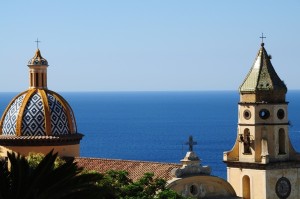
A giant mosaic filled piazza lingers in front of the town’s church as cotton candy colored pink fills the sky and sea. You can see Positano from here. When the sun begins to set, the lights in Positano come on like orchestrated bells. Signs caution not to play kick ball in this mosaic studded space. Despite the signs, local children pass the evening hours here, training to be the next calcio stars of Italy some day. Italians have never been rule keepers.

During the day, Praiano turns up the volume, but only slightly. In summer months, you can weave past local homes and streets so small you can’t believe they are streets to reach the local beach. The walk down may have you huffing and puffing like the big bad wolf, but the peace that comes is worth the workout. If you need somewhere to ring in your birthday this year, it is impossible not to have a good one in Praiano.

Would you like to have your photos featured here? Email me at suzy@suzyguese.com.

December 9, 2010

Under Travel Pressure

Under Travel Pressure

A giant book bearing the title Italy sits on my coffee table. Truth always be told, I never really looked at the book until the other day. I had flipped through it when I received the Modern Language Award at my college, appropriately deemed “The Dante Award”. Two women, Costanza and Maria Grazia, my Italian professors who inspired much of my love for Italy, gave the book to me as a gift for winning the award.

After spending three months in Italy this summer, a country I have spent years living in, I was somewhat sick of Italy. Reading other travel blogs and articles almost convinced me I needed to step outside my Italian comfort zone and head off to Asia, Australia, South America and even my own backyard in the USA. Florence became routine and I wanted a change.

Just days before heading home, I spent some time in Rome. I fell back in love with Italy and realized I just needed to shake up my Italian cities. I have already gone through those feelings of being a travel cheater, the type that keeps going back to the same place. I guess I am still battling those feelings.

Dante knows about travel pressure and he's not happy

Italian Studies became my life in college. While I was also a Communication major, Italian Studies was my other half, the classes I would look forward to each day. I was Italy obsessed and everyone knew it. Everything about the country fascinated me, the language, the people, the food, the scenery and the history. I know Italy is not a “hardcore” destination to some. It is quite Western in the opinions of most, but for me, much of the country is heavily ignored.

Being a travel writer today, I guess I feel this pressure to cover other destinations outside my expertise. Will anyone stick around here if I just cover Italy and Western Europe? I’m not a RTW writer. I’m not planning on strapping on a backpack and working in a bar for a few months all over the globe. That is a great option to travel for many, but not for me. Since I graduated college, I set out to be a writer. I haven’t had some job I hated and needed a “career break” as they call it. I just began doing what I am doing from the start. With that said, I feel very lonely, quite out of the loop with the rest of the travel world. I guess I’m not as adventurous. I’m not leaving it all behind to travel.

Perhaps there are other writers or even readers out there that love a destination but feel pressured to covered them all. Don’t get me wrong. I would love to see the world, but when did seeing the world become just stopping here and there and not really living that world for a while? In the end, it seems travel interests are fleeting. You may love one destination, but as travelers we try to go where we haven’t been before. I wouldn’t mind challenging that notion, the idea that even if you have been somewhere, you haven’t seen it all.

I face a few options in the New Year with my travels. The world really is my oyster. I can go somewhere outside of Italy and Europe. I can head to places I had never dreamed. Or, I could go back to Italy or Ireland or Germany, places I feel a strong connection to and spend as much time as I can. When I sit down to recreate a moment I had in Italy or Western Europe for that matter, the words flow easily and are thus more powerful to me and hopefully to you. Perhaps my redheaded temperament is calling me to not cover the globe but bits and pieces at a time.

Do you feel pressured as a travel writer to cover the globe? As a reader, do you feel you shouldn’t go back to the same place?

November 30, 2010

Remembering Places and Having Places Remember You
Remembering Places and Having Places Remember You

I walked into my favorite lazy day café in Sicily, part bookstore, part chocolate paradise. I was nervous to enter for it had been over a year since I came here every Sunday, especially when the weather turned bitingly cold.

I thought I would glance at the Italian books, maybe get ambitious on my plane ride home and read an Italian novel. Then I heard the sweetest of sounds come from the hot chocolate bar. “Sei ritornata!” Those words translate as you might imagine, “you have returned”.

Behind those words was the woman who ran the café, a glasses on the tip of her nose, frizzy haired Sicilian. I never had a formal conversation with her. I never really knew anything about her. She just was the giver of liquid chocolate, complete with complimentary cookies. She gave me that recognition of a stranger, that confirmation I wasn’t just a ghost that used to linger around this town.

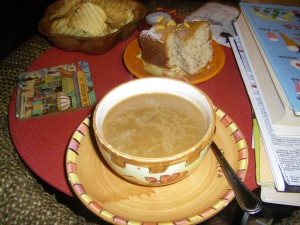
Sicilian hot chocolate complete with cake and potato chips

I quickly turned around, flustered and a bit surprise she would remember me. It probably showed on my face as I said yes, I had returned and how surprised I was that she remembered. She kept saying, “Certo! Certo!”, Certainly! Certainly! in English.

Travelers often forget that when they leave a place and come back, they may have never left. I have reflected on going back to Sicily after a year of being away before. Feelings of not fitting into to the town I once called home were apparent. My apartment wasn’t mine. My gelateria was closed. The streets just didn’t look the same.

Walking into another shop that day, a store I never entered on my time spent in Ortigia prior, I was on the hunt for a ring. I often pick up a ring wherever I go. I like to gaze down at my hand and recall where, when and who sold me that ring. It is my attempt to keep these places at my fingertips so to speak, my act of memory.

I started looking around the closet of a store as a little old woman in a blue suit looked up from her newspaper. I greeted her and went about looking and then I heard, “Sei ritornata!”. A store I never entered and a woman whose face I never noticed remembered my presence in town. I expressed my surprise yet again as the woman said she saw me pass by all the time when I lived here a year ago.

As travelers these people and places enter our lives. There are a few things that tie us to a place. It could be as simple as a ring on your finger or it could be a length of time. What I think we forget are a setting’s ties to us. We get so bogged down in remembering a place and our ties to it, loading up every finger with rings, when we forget that place is just as much trying to remember us as we are trying to remember it.

These two women with their “Sei ritornata”s gave me that sense. While life goes on in these places you leave and your life goes on, there are still those ties, those acknowledgments of remembrance. I like to think of it as we need to feel special. I once walked into a Starbucks while out of town and had the man behind the counter thank me for submitting my application. I looked at him puzzled and said, “I’m not from here”. He quickly apologized saying, “Well someone that looked just like you was here.” I told him I thought I was special. I thought I looked different. He said, “Well there are however many billion people in the world, so you’re not so special”.

I may look like a ghost, but I'm hoping the city behind me doesn't think I am.

Being a traveler can be a way of feeling more special, even if there are billions of people just like you. You don’t look like everyone else depending on where you go. You can stand out with clothing or culturally ingrained mannerisms. You, in the process are special, but not in the eating the paste sense. Locals may remember you more. Settings may seem to eerily embrace you. Rather than trying to remember a special place, we must consider that feeling of having a place remember us. It creates an overwhelming sense of connection, one you need to gain through travel. You have returned and the place is returning to you.

Have you had a similar experience where a place remembered you? Why do you think it is important for places to remember us as travelers?

November 15, 2010

Learning Italian and How To Travel From The Nonna
Learning Italian and How To Travel From The Nonna

BUZZZZZ! BUZZZZ! “Non lo so! Non lo so!”, my driver Giovanni kept saying as he pressed the buzzer to my new home for the next month. 18 years old and for the first time in a foreign country alone, I began to wonder what I got myself into as it appeared nobody was home.

Hand gestures and phone calls commenced as I sat on my suitcase wondering why my Italian host family wasn’t answering their bell. Did they already regret their decision? Will I have to live on the street? Questions in my mind mixed with an overzealous imagination that errs on the worried side more than the carefree.

Coming from an insignificant doorway, an older woman and a young girl walk/jogg out to unlock the gate. Once Giovanni sees someone has answered the bell, he couldn’t have climbed in to his van faster. Well, there goes my first friend in Sorrento.

The grandmother-granddaughter pairing didn’t greet me with hugs like I imagined. In fact, I didn’t know what I imagined, signing up to live with a host family for a month in Sorrento, Italy. The grandmother began grabbing my bag even to my English-Italian protest. “Faccio io! Faccio io!”, she kept saying. With jet lag and fear hanging over, all of the Italian I had picked up in one year in a classroom in California soared out into the Sorrento sky. Tongue-tied and tired, they showed me to my room, pointing to the shower. I can take a hint in any language. “Alle otto per cena, OK?” I mustered up a “Sí” and went straight for the shower.

Sorrento Harbor with Mt. Vesuvius standing guard

Buzzzz! Buzzzz! My finger pressed the doorbell to my host family’s main house, the Santostasi familia. On the other end of the wooden door, four women gathered, looking anxious and excited at the same time. I was quickly introduced to Anna Maria, her daughter, Luciangela, and her two daughters, Annabella and Aurora.

Ushered out to their terrace for dinner, I sat down awkwardly as I heard Volare playing from a nearby apartment. I seemed to have found myself on a movie set of what dinner with a southern Italian family would resemble. That awkwardness would soon fade as the days went on. Not knowing how to communicate with people you first met feels akin to having your mouth taped shut and arms tied behind your back. You would love to remove the tape, but you don’t have the arms to do so.

Luciangela warns before diving into my first plate of pasta at the Santostasi household, “You don’t leave here without gaining weight. La cucinia di Nonna!” I found Luciangela to be accurate in her statement, probably 5 pounds later.

Nightly, these conversations over too much pasta and oil turned into lessons on what it meant to be Italian, from speaking to acting. The family of women proved strong. Luciangela was a gymnastics teacher with a passion for performance. Annabella hated her name in typical teenage fashion. Aurora, 7 years old, would always speak to me as fast as she did with her mother. A child doesn’t have the patience to sit there and slow language down. Keep up or else seemed to be her motto.

“The Nonna”, Italian for grandma, as I grew to call her, didn’t speak a word of English. Well, that’s not true. Strangely she knew the word ceiling. She became family, the woman who sat with me in the morning as I sipped on espresso and munched on Italian cornflakes. She would ask me questions repeatedly. If I had no clue what she was saying, it didn’t matter. The Nonna would keep at it by finding a different way of phrasing the question or by bringing in props to lend meaning.

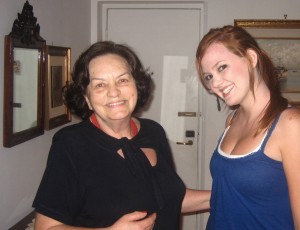
The Nonna and I

The Santostasi familia not only gave me my first taste of Italian in practice but also travel in essence. Up until that point in my life, every trip I had made was connected to family. Nothing was my own. Nothing was a complete self-achievement. I kept coming back to why I came here, to learn Italian. Woven into my love of the language was a desired to cover the country on my own, to travel independently devoid of familiarity to cling to.

My Italian strengthened more in one month than it did spending a year studying in California. It was the emotional attachment with this family, the nightly dinners, the morning coffees. I had to speak Italian, but I also wanted to, to better understand the Nonna and her generations of women seated around the table.

As I said goodbye in the early hours of the morning to catch my flight home, the Nonna handed me a glass jar filled with artichokes. Never seeing much emotion from her besides laughter and joy, I waved to her from the courtyard I nervously stood in a month before, dumbfounded and clueless when it came to studying Italian. I quickly realized the meaning of language learning. It was for this moment, this connection. Cariciofi, otherwise known as artichokes, is still my favorite Italian word and I suspect the Nonna has something to do with it.

This is my entry for the  Pimsleur Approach Language Learning Blog Contest.

November 12, 2010

Rome, Italy Wishes You Were Here

Rome, Italy Wishes You Were Here

I was beginning to fall out of love with Italy. After three months of living in Florence, I grew tired of little Italian nuances I used to find charming when I studied abroad. When a place starts to lose its magic, it is usually time for you to go home, get perspective and appreciate it all over again.

When I was 14 years old, I fell in love with Italy in Rome. Perched at the Trevi Fountain lapping up a gelato, there was something about that evening that dictated the rest of my life. When I returned to Rome this past September before catching my flight home, I became reacquainted with the city and discovered I wasn’t falling out of love with Italy.

Pulling a Gregory Peck at the Mouth of Truth

Just south of Vatican City and on the west bank of the Tiber River, the neighborhood of Trastevere won Italy back for me. An area I had never covered on my many trips to Rome brightened during the day with streets for strolling and classic Italian images like the one below.

Trastevere, Rome

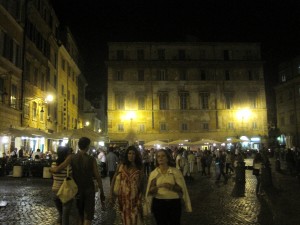
At night, Trastevere invades with tourists and locales, wining and dining. Performers fill the squares as some gather around them. Two Italian women begin their nightly stroll, fashionable and complete in their apparel. They have looks on their faces as though this feeling is normal, that the city of Rome has always been this way, powerful, magical and attitude changing. I fell back in love with Italy, with the same emotions of that 14 year old in Rome some 10 years later.

Would you like to have your photo featured here? Email me at suzy [at] suzyguese [dot] com.

October 29, 2010

Matera, Italy Wishes You Were Here

Matera, Italy Wishes You Were Here

Silence is hard to find in Italy. Noise of some form is bound to find a way into the most isolated stretches of the country. From their garbage trucks to Italians in general, finding peace and quiet in Italy can be a challenge.

That is, until I reached Matera, a town located in the southern region of Basilicata, in between Calabria and Puglia. Matera is considered one of the oldest settlements in the world, with the first inhabited zone dating back to Paleolithic times. These settlements formed in the earth with caves, called sassi.

Tiny "sassi" in the hillside of Matera, Italy

However, Matera is not merely known for its old age. The town was also the site of one of Italy’s great scandals. In the 1950s, people began living in the sassi due to overwhelming poverty. A playground for disease and a 50% infant mortality rate caused the government to step in, forcing residents out of their caves and into government housing. Matera continued to draw attention when Mel Gibson rolled into town, selecting Matera to be his Jerusalem for The Passion of Christ.

Wandering through Matera, I thought I heard a few pins drop. With no residents to be seen and just empty caves surrounding, Matera didn’t strike me as beautiful, but rather one of the most haunting places I have ever been. A great deal of life and death occurred in such tiny little openings. We often don’t think of Italy holding such poverty, so developed and Americanized some believe. Head down to the country’s south and you may find that lingering eeriness.

Would you like to have your photo featured here? Email me at suzy [at] suzyguese [dot] com.

October 27, 2010

The Poor in Coffee at the Santa Maria Novella Train Station

The Poor in Coffee at the Santa Maria Novella Train Station

The day I left Florence, a man emptied his pockets. Dressed in a fine Italian suit, the smaller in stature Italian reached into his pockets and emptied them for the hand outstretched in front of him.

The Florence Train Station, Santa Maria Novella, can be a place of chaos. College backpackers settle into the floors, sleeping until the next train out of town rolls into the platform. Masses of people congregate in front of the departures sign, waiting and waiting for their platform number to finally be listed. In typical Italian style, it never shows up until just before the train is set to leave. Men driving little carts honk their horns at unsuspecting travelers in the way as they pick up specks of trash. Balancing a cigarette in their mouths while doing so should be a circus act. Trains unload with passengers going every which way, frantically trying to get out of this setting and get to Florence. A place where so many weave through at busy points in the day, you almost feel you need a turn signal attached to your back to make it out alive. Lives and trains are crossing paths and many don’t even realize it.

Much of traveling involves waiting in a crowded setting. For some this is eliminated with their sense of time. Some travelers prefer to be at the gate or train platform a good 30 minutes before departure. Others swiftly walk on to the plane, train or bus, minutes, if not seconds, before their mode of transport is set to leave. Those that know me understand, I must be early, no matter what. That waiting usually transpires in a chaotic setting. These settings are usually forgotten for they are just a means to an end of getting to our preferred setting. However the bus terminals, train stations, and airport gates provide diversity in people and story unlike anywhere else. You will find people going in all different directions, of different backgrounds and in different states of mind.

As I sat on my suitcase in the station, waiting for my train to Rome, I observed this woman, dressed well, go around from person to person, asking for money. One after another, I saw people walk away from her, shaking their heads. As she walked up to me, she asked in Italian if I spoke Italian. I said yes and to her excitement, she let out her sob story. Except, her sob story didn’t make me tear up or want to give her spare change. She said she needed money for a caffé. Only in Italy, I thought.

Having not had time or spare change for a caffé myself, I quickly said no and she went on her way. Then I watch her approach this nicely dressed man. Perhaps she didn’t give him the same sob story, but he gave her all he had in probably his Armani pockets. I watched her continue, even after no doubt getting enough change for a shot of espresso from that man, go around from person to person, continuing her story of needing coffee.

Then, another man enters the picture, going around, asking for money. He approaches the well-dressed man, who empties his other pocket and goes back to reading his newspaper with black-rimmed glasses on the tip of his nose. What I failed to acknowledge when I quickly dismissed the woman was her honesty and dishonesty all in one. Pitied or scorned, the man in Armani clearly didn’t care.

Most train stations lack seating where train times and platforms are listed. Perhaps it is to keep those from sleeping on benches. Then again, it could be so that I could take in this story from the low level the ground provides, the woman who needs money for loads of coffee, the man who gives and gives to get back to his newspaper, and me. The setting here is key. A train station sees people coming and going. Some wander around looking for money to go. Others remain clueless about the automated ticket system and forget to pick up their just purchased 50-euro ticket. Get to the train station early. You never know what you might see.

Have you observed an interesting scene or story while waiting on a train, plane or bus?