Archive | Italy RSS feed for this section
August 12, 2011

Sardinia, Italy Wishes You Were Here

Sardinia, Italy Wishes You Were Here

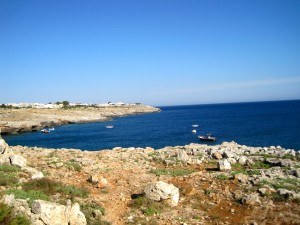
On every traveler’s lifeline, there are points where you believe you have found a place that is all yours. You don’t know this will be the result when you board that plane, train or bus. That is to be expected, the beginnings for surprise. Sardinia is my place, or at least, it was. A Catch 22 lies with calling a place your own for there is always time, season and position working against you. A second visit to Sardinia I suspect wouldn’t have the same effect as the first. The first time I fell for Sardinia probably came while watching the wind blow through cliff-hanging shrubs. The sea was perfectly cobalt and the rest was flawless.


I swooned over several aspects to Sardinia. I think it began in Cagliari, the port town founded in the 7th century B.C. by the Phoenicians. With the Golfo degli Angeli, the Gulf of Angels, watching over this city, at night, Cagliari gives off an enchanting glow. With views of the Cagliari port and coastline, the Medieval Castello quarter is the only place to be at night in Sardinia’s capital city.

I drank Sardinia’s love potion again just outside of the town of Fluminimaggiore. Say that three times fast. The Tempio Punico-Romano di Antas stands so isolated and mysterious. You can stand in the 1st century B.C. Roman place of worship, which doesn’t seem right for preservation reasons. Regardless, I perch here and imagine the civilizations that have done the same.

As if ancient temples and glowing cities weren’t enough, Sardinia even gives me my own private island, Isola Rossa. Near the town of Teulada, I discover the Beach of Porto Tramatzu where I haven’t felt sand so silky. Whenever a beach describes itself with “fine, white sand” I am always a little skeptical. Here, “fine, white sand” doesn’t do the beach justice.

Rising out of the sea as though someone just pressed a button to make this appear to me now, Isola Rossa, otherwise Red Island covers in typical Mediterranean vegetation and a coppery hue. It is an island best seen from above.

The temples, private islands and golden cities aren’t enough. Sardinia even has to show off its Phoenician settlements, still stuck back in the 8th century B.C. Nora, near the town of Pula, has traces of Roman, Phoenician and Punic civilizations. Ruined housing quarters and an amphitheater are endearing, but it is the preserved colors and designs of the Roman mosaics here that intrigue me. The mosaics are proof that the ancients believed a work of art should always be at your feet.

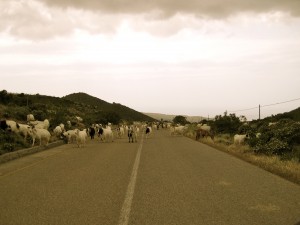
Most of the traffic I encounter comes in goat form. The Italian island is so far removed from my reality that for a few days, and those days only, it is all mine.

August 5, 2011

Taormina, Sicily Wishes You Were Here

Taormina, Sicily Wishes You Were Here

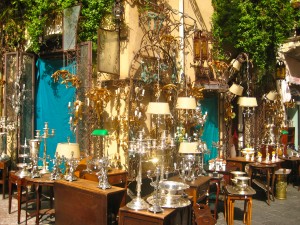
On the streets of Taormina, I stumble over the clutter of antique shops spilling out into the streets. The clutter is not limited to objects, but also people. Taormina is not the sort of place you come to for anonymity, but rather to see and be seen. Throughout history, writers, artists, aristocrats, royalty and celebrities have vacationed in this resort town on Sicily’s northeastern coast. Despite all of the activity in late summer, the shine of Taormina, right down to the glaring sun off of those sliver antique candleholders is endearing to say the least.

I make my way to the town’s premiere attraction, the Teatro Greco. Constructed in the 3rd century B.C., it is the second largest on this island. Scaffolding is up, hinting a production is eminent. In Taormina’s warmer months, performances take the stage here.

Set in between the sea and sky of Taormina, Teatro Greco proudly holds one of the best views of the town. One particular bend is a stopping point for pictures by most who pass through here. Even the skeptical of this tourist town can’t deny this view, myself included.

I continue on to Piazza Duomo, the center of activity in any Italian town. Taormina’s Duomo almost looks more fortress than religious institution. The 13th century cathedral fills on Sunday nights with locals taking a seat on wooden pews.

Taormina’s perfection makes a full circle at Villa Comunale, the city’s gardens. Created by an English woman, the hanging gardens present a lush paradise in the midst of a coastal dream.

Clutter aside, Taormina’s appeal comes in its position, up high on a hill, almost like that forbidden toy as a kid, up high on the top shelf. However, Taormina still can’t compete with Mt. Etna glaring in the distance.

As rain approaches, the active volcano turns unquestionably gray, but Taormina is still keeping up shiny appearances right down to its own private island, Isola Bella.

May 27, 2011

Locorotondo, Italy Wishes You Were

Locorotondo, Italy Wishes You Were

When you read that the most beautiful village in all of Italy is just a few miles away, you can’t fight the urge to go and judge for yourself. Italy crawls with villages that could easily be the most beautiful in all of the country. Locorotondo in the country’s southern Puglia region has the coveted title of one of the borghi piú belli d’Italia, otherwise, one of the most beautiful villages in Italy. I had to go and see for myself.

Coming up on Locorotondo, my skepticism got the best of me. It didn’t look like much, a city on a hill but not one a pilgrim would write home about to relatives across the pond. Getting out of my car, I was quickly blinded by Locorotondo and all skepticism stepped aside.

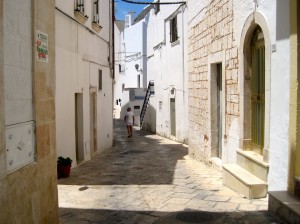
The village only colors in one shade of crayon, white. The buildings uphold this trend and so do the locals it seems. As I wandered the streets of Locorotondo, I discovered the uniform in town, white shorts, white shirt, no problem.

The only pops of color come in flower boxes where blood red flowers add simple, yet effective contrast to Locorotondo’s all white state of mind. Perhaps it was the hour of the day, but the town felt deserted, left here perfectly paradisal.

The few shops open in Locorotondo show off the village’s specialty, none other than white, light and sparkling wine. For those who can’t appreciate a good glass of white wine, Locorotondo does provide a respite for your sunglasses. As the village sits on a hill, you can gaze out onto a green valley, speckled with what appears to be Locorotondo’s influence trickling down to the countryside in white building form. Officially one of Italy’s most beautiful villages, this skeptic agrees. Locorotondo looks good in glistening, blinding and angelic white.

May 8, 2011

The Aeolian Islands of Sicily Wish You Were Here
The Aeolian Islands of Sicily Wish You Were Here

This week’s Wish You Were Here post comes from Matt McCall.

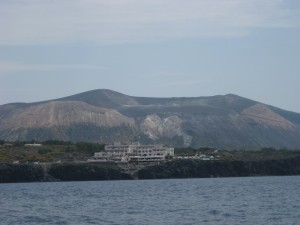
As the weather is finally warming up, I find myself often daydreaming of past trips to the Mediterranean. On one trip to Sicily in the early Spring, I ventured to the Aeolian Islands to the northeast of the mainland. Only having one day to make it out to the islands, I was able to see the islands of Lipari and Vulcano.

The ferry took me from Messina to Lipari, the largest of the seven islands. Immediately after departing the ferry, I was greeted by people wanting me to book any combination of boat ride offers. I normally do not jump at such offers, but on this day, the spirit of island adventure intrigued me. The trip included a trip around Lipari island with a stop for swimming followed by a two hour stop on Vulcano. While ultimately the swimming stop turned out to only be about 15 minutes long, it was some of the clearest water I have ever seen, tucked away in a remote corner of the island.

Afterward, the trip continued on to Vulcano, where the ancient Romans believed the god Vulcanus abided, making weapons for Mars. They believed that the ash and smoke from Vulcano came from Vulcanus’s workshop chimney. You can still see the giant smoking gently today. The Romans used the island for harvesting raw materials, including sulfur, the smell of which will sting your nostrils as soon as you step off the boat.

Today, you can go to the island and enjoy a sulfur mud bath or Laghetto di Fanghi. After soaking in the sulfuric mud, you jump into the Tyrrhennian Sea to rinse off and then rinse that off with a cold outdoor shower. The effect is good for your skin and your health, at least so they say. Be warned, however, to wear an old bathing suit that you can throw away afterward, for the sulfuric smell will want to stay with you as a memento if you let it.

Have you been to these islands or any of the other five?

May 5, 2011

Redhead Reviews: A Moment in Italy—Original Photography and Custom Cards
Redhead Reviews: A Moment in Italy—Original Photography and Custom Cards

Full Disclosure: I received these products free of charge, but my thoughts and opinions are my own.

Not everyone can travel indefinitely. If you are like me, you travel throughout the year, but you also have a home base. When I am at home, I like to soak up the comforts of home, but I also like to be constantly reminded of travel. I have old suitcases functioning as side tables. Guidebooks fill my bookshelves. If I don’t have that constant reminder of travel in my home, it would be difficult for me to pass time in between the next great adventure.

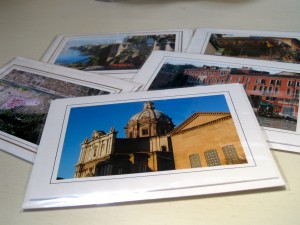
Rosann Evans asked me to take a look at her originally photography and custom cards business, A Moment in Italy. Being that I love Italy and seeing images of the country on a constant basis, I was more than happy to check out her cards. Like me, Rosann only has eyes for Italy and so does her camera.

What is A Moment in Italy?

Rosann started making prints for family and friends after frequent trips to Italy. After such praise, she decided to make her moments in Italy a business.

Evans explains of her photography, “Being a photographer in Italy is like cheating a little—she is a perfect model. I don’t think she can take a bad picture.  Perhaps it’s because I am so enamored by this country that I find each little facet of the landscape and architecture inspiring.”

What I Liked

Rosann sent me six of her custom prints to review, 4×6 photographs framed in 5×7 natural cards. From classic shots of Venice’s Grand Canal to more subtle observations of Italy such as laundry flapping in the wind, Rosann captures the spirit of Italy. I appreciated the diversity of her images, from the famous to not so famous yet iconic Italy.

Her goal is to allow the viewer to have moments in Italy, even if you are far from it. I have placed her prints around my apartment, just as reminders of how beautiful and exciting travel and travel to Italy, can be. I also like how accessible her prints are. At $3.95 apiece, anyone can afford to have a moment of Italy or send one to a friend.

I also could admire how passionate Rosann comes across in her work. On some of her cards, I received her words about the image on a tiny piece of paper within the card. It is nice to have the personal touch to an item as it made me feel a connection to her travels in Italy.

What Could Be Improved

As Rosann’s prints are in framed cards, they are intended to be cards you can send to others. Rosann sends you an envelope and in some cases, little blurb about the print. However, if you want to keep the prints and not use them as cards, it would be nice to have some sort of stand so that they could easily be placed on side tables and on counters, like a picture frame. At the same time, it seems like you could easily place the prints in picture frames if you want or just stand the cards upright on tables.

Conclusion

If you are looking for an affordable way to bring Italy to your home while you wait for the trip funds to grow, Rosann’s A Moment in Italy is an affordable way to do so. Her cards also make great greetings to others looking for a hint of travel in their mailbox. With the personal touches of a travel, her prints aren’t like buying those off of a major website, but rather like gaining a piece of someone’s private nomadic journeys.

For more on Rosann’s work, visit A Moment in Italy-Original Photography and Custom Cards.

April 22, 2011

The Churches in Europe Wish You Were Here

The Churches in Europe Wish You Were Here

With Easter Sunday just days away, I am reminded of all of the houses of worship I have seen. In Europe, one church after another starts to blend together, especially if you are on some whirlwind tour. Regardless, these spaces evoke a silence and calm away from the rest of the world. Even if you aren’t a religious person, you can appreciate the architecture, history and peace that comes while sitting in a pew.

St. Kevin’s Church, Glendalough, Ireland


St. Kevin’s Church in Glendalough Ireland has that rugged appeal. The saint set up a monastic site here around 570 A.D. In the heart of the Wicklow Mountains, a mist hangs over the air, as the simple stone structure stands somewhat altered from its deep origins.

Jelling Church, Jelling, Denmark

The burial mounds and runic stones at Jelling are considered to be Denmark’s birth certificates. Housing the story of Denmark’s beginnings is the Jelling churchyard. I couldn’t enter the church for it was locked. However, I could imagine the last pagan king of Denmark converging with the first Christian king of the country on these grounds.

Capela Dos Ossos, Évora, Portugal

Perhaps the most chilling church I have entered is the Capela Dos Ossos, literally translating to the Chapel of Bones, in Évora, Portugal. Around 5,000 people make up the walls of this chapel. From one skull to the next, you can tell the differences in person. At the chapels entrance a sign reads, “our bones await yours”, spine tingling to say the least.

Fulda Cathedral, Fulda, Germany

A distant grandmother was baptized here; perhaps that is why I felt pulled in the cathedral’s direction. Then again, it could be its size. Fulda’s Cathedral dominates the town. On Sunday mornings, little old ladies scramble to get inside before the bells cease their chimes. The tomb of Saint Boniface also lies within the Cathedral.

Duomo di Santa Lucia, Ortigia, Sicily

The Duomo in Ortigia is by far my favorite church in Europe that I have seen. Along its sides you can see the columns to the Greek temple to Athena. The grand architecture is a symbol of changing of faith, going from the belief in several higher powers to just one with its baroque façade. It faces a blindingly white square as it tells just what religion can be throughout time. The faiths may change but the structures are still the same.

Do you have a favorite church, mosque or temple from your travels?

Would you like to have your photographs featured here? Email me at suzy@suzyguese.com.

January 14, 2011

Paestum, Italy Wishes You Were Here

Paestum, Italy Wishes You Were Here

Heading south from the Amalfi Coast, Paestum tucks away from the tourists and crowds that seem to linger solely at Pompeii. Having never heard of this ancient site, I figured it was worth the gamble to go see. The UNESCO listed temples of Paestum seem like a well-kept secret. With only a handful of tourists wandering around the site in the heat of summer, I could appreciate Paestum fully, letting my imagination run wild.

All that can be heard amidst the reverberating locust’s song are the sounds of history lingering. The Greek settlement of Paestum contains some of the best-preserved temples from Magna Graecia, the Greek settlement that covered most of Italy’s south. Built for Poseidon, god of the sea, Paestum’s origins date back to the 6th century B.C.

Paestum holds three temples, largely intact and readily accessible for the imagination. It is hard to believe they weren’t discovered until the 18th century, when road builders nearly plowed right through the ruins. Protecting Paestum, a wall surrounds the settlement, seemingly keeping out the modern souvenir stalls and restaurants right on its edge.

The largest and best preserved temple remains the Temple of Neptune. With not a soul around, I can feel the ancients offering up whatever they had to Neptune, in hopes of surviving the heat of the Italian summer. Art students sketch outside the temples, making for a scene of record, of remembrance. Paestum may not have the fame of Pompeii or the ruins in Athens and Rome, but it should. If you are looking to have 6th century B.C. ruins all to yourself, largely preserved, look no farther than Paestum. Time travel is possible here, for nothing of modernity can obstruct the imagination here.

Would you like to have your photos featured here? Email me at suzy@suzyguese.com.