Archive | Italy RSS feed for this section
December 23, 2011

Milan, Italy Wishes You Were Here

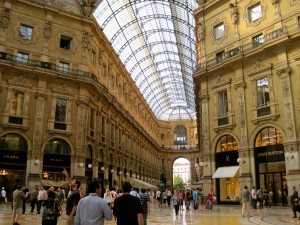
The last place you will find me this time of the month is an indoor shopping mall. It is a place all should avoid for fear of being spritzed with the latest scent by a celebrity or for fear of being rundown in the parking lot by an SUV. However, the first place I found in Milan was just that, the original indoor shopping mall, Galleria Vittorio Emanuele II.


What would become Milan’s idea of a shopping mall in the 19th century, the Galleria Vittorio Emanuele II opens up to a dramatic archway. Within a ceiling of steel and glass, you can still spot the heavens. It’s design takes on the shape of a crucifix for what I believe to be purposeful. We all need divine intervention when braving an indoor shopping mall.


The designer of it all, Giuseppe Mengoni, died just days before he could see his creation opened to the masses of Milanese. It always seems creators of great works of art and architecture often never get to fully appreciate them. Something tells me Giuseppe probably didn’t anticipate these fashions to grace the interior of his work.

Today’s Galleria Vittorio Emanuele II is a melting pot of this fashion-forward town and every tourist who has decided to give this commercial city a chance. A gaggle of Buddhist monks even stop to admire the windows of Prada.


And yet just off of this monumental indoor shopping mall is the city’s center of faith, the Duomo. The Gothic Cathedral is so detailed, covered in saintly statues, flying buttresses and spires, that I could stare at it for hours and never fully grasp its entirety.


I enter what is said to be the fourth largest church in the world, a place of worship that can hold 40,000. I am drawn to my feet, where a pattern of red, black and white marble flooring infects the entire interior.

Begun in 1386, Milan’s Duomo boasts 135 spires and over 3,000 statues. It holds a 4th century baptistery where Saint Ambrose supposedly baptized Saint Augustine. Travelers know of the saint’s famous quote, “The world is a book and those who don’t travel read only but a page.” The quote is about as overused as a kitchen dishrag, but at the same time incredibly accurate. I could live knowing the evils of the indoor shopping mall or believe a church is just a church, but thankfully I have traveled to Milan and seen this is not always the case.

I am standing in the middle of a structure that took five centuries to create, a place where no detail was left unturned. Right next-door is a shopping mall, intended to beautify not complicate. I might not want to enter a shopping mall this time of the year, but I would gladly enter Milan’s idea of what retail should be. And I would know that I will get out alive with a crucifix over my head. Milan wishes you were here…


Have you been to Milan?

December 21, 2011

Sweet December Travel

He stirs the mixture of hot sugar, just one point in the process to create a simple candy cane. A father lifts his son on his arms to see the silver saint as an entire island elbows in between. And a lighthouse watches over a Christmas tree composed solely of lobster traps. I don’t often travel in December, mostly due to family filled schedules and of course the chaotic airport scene. After boarding a flight on Monday, a boarding process that took far longer than it ever should, I watched as people jammed their holiday gifts and jackets in the overhead bins, ignoring all announcements to leave the space for those with actual bags. It is not always a pleasant scene, the act of December travel. Snowstorms, inexperienced travelers and the overall stress of the holidays don’t always lend the best of recipes.


When I do travel in this month, I have managed to uncover a sweet December, a month unlike any other time of year. One of my favorite aspects to travel is its ability to connect one person from another culture or background with another. December might be the best month to see this first hand traveling. Most of the world is doing something different from the rest of the year, whether it is putting up extra trees about town or finding a certain faith in tradition. It is December that connects the traveler to customs of their home, even if they may be half way across the world. It is the act of tradition, the act of doing something special and different that makes this month the same for us all. While my travels haven’t led me too far away from home for December, I have found a few moments away from the familiar and entrenched in an undeniable connection found in this magical month.

The Nubble Lighthouse, Maine

On the southern coast of Maine, you will find the Nubble Lighthouse near York village. Perched on its own green island, I visited this site when most wouldn’t dream of getting out of their cars, December. The wind whipped me into a spinning shivering mess, but I didn’t care. The lighthouse to me was iconic December. With no sun in sight, the white and red lighthouse oozed the holidays.


Just across from this famous lighthouse, a restaurant set up its own holiday decorations, a lobster trap Christmas tree. Countless traps went into its construction, something you would only see in this part of the world. It was Maine’s spin on December and yet still a familiar sight.


Candy Cane Factory, Colorado

It’s not everyday you sit down and ponder how your candy cane came to be. Hammond’s Candy Cane Factory offers free tours of just how those classic December treats are made. Turning out 1,000 pounds of sugar a day, Hammond’s began in 1920.


I toured the factory several Decembers ago. While mostly children participated in the tour, I watched as employees of the factory twisted, pulled and pushed sugar into the red and white ribbons of a candy cane. As I watched behind a glass window, you could see the smirks on the candy cane makers faces. To them, it was a job. To most of those watching, they were pure Christmas elves. This candy cane factory visit reminded me that every aspect to December travel, right down to those candy canes you see everywhere, is an entire process, one that calls for several individuals to make successful, not just one.


Sicilian December Festivals

I had never traveled outside the country for December until I studied in Sicily. I was able to participate in two of the island’s biggest events, the Feast of Santa Lucia and the Feast of the Immaculate Conception. On December 6th, the town of Siracusa parades a statue to Mary throughout small, snaking streets. It is still a sight I can’t wipe from memory, countless Sicilians so dedicated and devoted to a single cause.


Later on in the month, the town and island celebrates Santa Lucia, Sicily’s patron saint. On December 13th, all of Sicily seems to arrive to Siracusa’s Piazza Duomo. Fathers hoist their children on their shoulders in hopes of catching a glimpse of Santa Lucia, a silver statue to the saint hailing from the 16th century. The town processes yet again through the streets of Ortigia, with several men needed to carry Lucia. In old uniforms and costumes, I watched this scene from my Sicilian balcony.


December might not be the best month for travel with chaotic airports and hefty ticket prices, but it is all worth it to me in the end to see the powerful link of tradition and the shaking up of routines across the globe.


Do you travel in December? Have you found more events and iconic cultural moments throughout the month?

August 26, 2011

Italy’s Stiletto Wishes You Were Here

Heading south from Otranto, I follow the SP358, the road in Puglia that hugs the coast down to the point of no return in Italy. The howling of crickets and the sound of the breeze out the car window creates an enchanting song. I have always had images in my mind of what the very point of Italy’s boot heel would look like. Almost like my El Dorado, I have high hopes as the path to this Promised Land continues to wind.


Tiny coves with beaches only further my excitement. So far removed for any Italy I have known up to this point, I continue to head south, imagining what it would be like to live along the end of Italy as a few do.

As the anticipation builds, I come across a strange sight, a taste of architecture far from the Italian villa style. Villa Sticchi stands a little run down and out of place amidst nothing. The Moresque style hints at the seaside resorts of old. Built for Giovanni Pasca, the first concessionaire of the Santa Cesarea thermal baths, its appearance only furthers my feelings that this place is of fantasy. Constructed by Pasquale Ruggieri, Villa Sticchi plays on his passion for the east.


And with each passing mile, I am closer and closer to Italy’s end, right near the town of Santa Maria di Leuca. Just beyond is Punta Ristola, geographically the lowest point of Italy. Saint Peter is reported to have arrived here to head up to Rome. The Greeks have long told mythological stories of reaching this point. A place with so much to live up to, Italy’s pointy stiletto is somewhat underwhelming. You can see the two seas meeting, the Adriatic and the Ionian, by the way in which the currents collide. While not really anything to write home about, it is and it isn’t. I’m at Italy’s conclusion, a point many saw as both the beginning and the end. And so I will write home about Italy’s stiletto. Wish you were here.

August 12, 2011

Sardinia, Italy Wishes You Were Here

Sardinia, Italy Wishes You Were Here

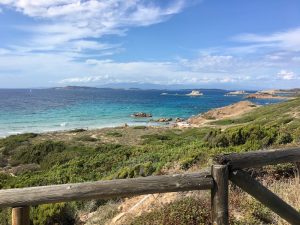
On every traveler’s lifeline, there are points where you believe you have found a place that is all yours. You don’t know this will be the result when you board that plane, train or bus. That is to be expected, the beginnings for surprise. Sardinia is my place, or at least, it was. A Catch 22 lies with calling a place your own for there is always time, season and position working against you. A second visit to Sardinia I suspect wouldn’t have the same effect as the first. The first time I fell for Sardinia probably came while watching the wind blow through cliff-hanging shrubs. The sea was perfectly cobalt and the rest was flawless.


I swooned over several aspects to Sardinia. I think it began in Cagliari, the port town founded in the 7th century B.C. by the Phoenicians. With the Golfo degli Angeli, the Gulf of Angels, watching over this city, at night, Cagliari gives off an enchanting glow. With views of the Cagliari port and coastline, the Medieval Castello quarter is the only place to be at night in Sardinia’s capital city.

I drank Sardinia’s love potion again just outside of the town of Fluminimaggiore. Say that three times fast. The Tempio Punico-Romano di Antas stands so isolated and mysterious. You can stand in the 1st century B.C. Roman place of worship, which doesn’t seem right for preservation reasons. Regardless, I perch here and imagine the civilizations that have done the same.

As if ancient temples and glowing cities weren’t enough, Sardinia even gives me my own private island, Isola Rossa. Near the town of Teulada, I discover the Beach of Porto Tramatzu where I haven’t felt sand so silky. Whenever a beach describes itself with “fine, white sand” I am always a little skeptical. Here, “fine, white sand” doesn’t do the beach justice.

Rising out of the sea as though someone just pressed a button to make this appear to me now, Isola Rossa, otherwise Red Island covers in typical Mediterranean vegetation and a coppery hue. It is an island best seen from above.

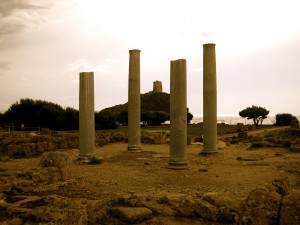
The temples, private islands and golden cities aren’t enough. Sardinia even has to show off its Phoenician settlements, still stuck back in the 8th century B.C. Nora, near the town of Pula, has traces of Roman, Phoenician and Punic civilizations. Ruined housing quarters and an amphitheater are endearing, but it is the preserved colors and designs of the Roman mosaics here that intrigue me. The mosaics are proof that the ancients believed a work of art should always be at your feet.

Most of the traffic I encounter comes in goat form. The Italian island is so far removed from my reality that for a few days, and those days only, it is all mine.

Would you like to have your photographs featured here? Email me at suzy@suzyguese.com.

August 5, 2011

Taormina, Sicily Wishes You Were Here

Taormina, Sicily Wishes You Were Here

On the streets of Taormina, I stumble over the clutter of antique shops spilling out into the streets. The clutter is not limited to objects, but also people. Taormina is not the sort of place you come to for anonymity, but rather to see and be seen. Throughout history, writers, artists, aristocrats, royalty and celebrities have vacationed in this resort town on Sicily’s northeastern coast. Despite all of the activity in late summer, the shine of Taormina, right down to the glaring sun off of those sliver antique candleholders is endearing to say the least.

I make my way to the town’s premiere attraction, the Teatro Greco. Constructed in the 3rd century B.C., it is the second largest on this island. Scaffolding is up, hinting a production is eminent. In Taormina’s warmer months, performances take the stage here.

Set in between the sea and sky of Taormina, Teatro Greco proudly holds one of the best views of the town. One particular bend is a stopping point for pictures by most who pass through here. Even the skeptical of this tourist town can’t deny this view, myself included.

I continue on to Piazza Duomo, the center of activity in any Italian town. Taormina’s Duomo almost looks more fortress than religious institution. The 13th century cathedral fills on Sunday nights with locals taking a seat on wooden pews.

Taormina’s perfection makes a full circle at Villa Comunale, the city’s gardens. Created by an English woman, the hanging gardens present a lush paradise in the midst of a coastal dream.

Clutter aside, Taormina’s appeal comes in its position, up high on a hill, almost like that forbidden toy as a kid, up high on the top shelf. However, Taormina still can’t compete with Mt. Etna glaring in the distance.

As rain approaches, the active volcano turns unquestionably gray, but Taormina is still keeping up shiny appearances right down to its own private island, Isola Bella.

Would you like to have your photographs featured here? Email me at suzy@suzyguese.com.

May 27, 2011

Locorotondo, Italy Wishes You Were

Locorotondo, Italy Wishes You Were

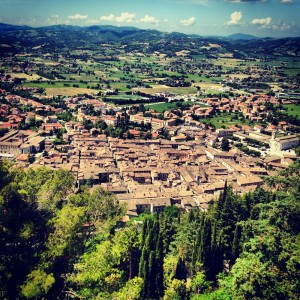
When you read that the most beautiful village in all of Italy is just a few miles away, you can’t fight the urge to go and judge for yourself. Italy crawls with villages that could easily be the most beautiful in all of the country. Locorotondo in the country’s southern Puglia region has the coveted title of one of the borghi piú belli d’Italia, otherwise, one of the most beautiful villages in Italy. I had to go and see for myself.

Coming up on Locorotondo, my skepticism got the best of me. It didn’t look like much, a city on a hill but not one a pilgrim would write home about to relatives across the pond. Getting out of my car, I was quickly blinded by Locorotondo and all skepticism stepped aside.

The village only colors in one shade of crayon, white. The buildings uphold this trend and so do the locals it seems. As I wandered the streets of Locorotondo, I discovered the uniform in town, white shorts, white shirt, no problem.

The only pops of color come in flower boxes where blood red flowers add simple, yet effective contrast to Locorotondo’s all white state of mind. Perhaps it was the hour of the day, but the town felt deserted, left here perfectly paradisal.

The few shops open in Locorotondo show off the village’s specialty, none other than white, light and sparkling wine. For those who can’t appreciate a good glass of white wine, Locorotondo does provide a respite for your sunglasses. As the village sits on a hill, you can gaze out onto a green valley, speckled with what appears to be Locorotondo’s influence trickling down to the countryside in white building form. Officially one of Italy’s most beautiful villages, this skeptic agrees. Locorotondo looks good in glistening, blinding and angelic white.

Would you like to have your photographs featured here? Email me at suzy@suzyguese.com.

May 8, 2011

The Aeolian Islands of Sicily Wish You Were Here

The Aeolian Islands of Sicily Wish You Were Here

This week’s Wish You Were Here post comes from Matt McCall.

As the weather is finally warming up, I find myself often daydreaming of past trips to the Mediterranean. On one trip to Sicily in the early Spring, I ventured to the Aeolian Islands to the northeast of the mainland. Only having one day to make it out to the islands, I was able to see the islands of Lipari and Vulcano.

The ferry took me from Messina to Lipari, the largest of the seven islands. Immediately after departing the ferry, I was greeted by people wanting me to book any combination of boat ride offers. I normally do not jump at such offers, but on this day, the spirit of island adventure intrigued me. The trip included a trip around Lipari island with a stop for swimming followed by a two hour stop on Vulcano. While ultimately the swimming stop turned out to only be about 15 minutes long, it was some of the clearest water I have ever seen, tucked away in a remote corner of the island.

Afterward, the trip continued on to Vulcano, where the ancient Romans believed the god Vulcanus abided, making weapons for Mars. They believed that the ash and smoke from Vulcano came from Vulcanus’s workshop chimney. You can still see the giant smoking gently today. The Romans used the island for harvesting raw materials, including sulfur, the smell of which will sting your nostrils as soon as you step off the boat.

Today, you can go to the island and enjoy a sulfur mud bath or Laghetto di Fanghi. After soaking in the sulfuric mud, you jump into the Tyrrhennian Sea to rinse off and then rinse that off with a cold outdoor shower. The effect is good for your skin and your health, at least so they say. Be warned, however, to wear an old bathing suit that you can throw away afterward, for the sulfuric smell will want to stay with you as a memento if you let it.

Have you been to these islands or any of the other five?