Archive | Arkansas RSS feed for this section
January 3, 2013

Fort Smith, Arkansas Wishes You Were Here

I am standing with one boot in Arkansas and the other in Indian Territory. Such a positioning back in the 1800s wouldn’t have been the safest of perches, especially for the traveler just passing through town. Fort Smith, Arkansas has long found its identity destined to its positioning in the world. This small settlement sets up on the Arkansas-Oklahoma border. It grew up as the area’s first frontier fort and served as a key point where Federal marshals rode out of the United States and into Indian Territory. The Wild West was just over the Arkansas River.

The dangerous border at Fort Smith 

Standing where I am in Fort Smith has an air of being dropped into the films that relied on this destined town for a setting, those like True Grit and Hang’em High. I realize just how rough and tough Fort Smith used to be while touring the Fort Smith National Historic Site. Set up in the restored barracks and courthouse building, the museum space details 80 years of turbulent history on the Western frontier.

 Fort Smith Barracks and Courthouse

I begin with the first fort, or at least what is left of it. The first Fort Smith was built in 1817 in order to keep the peace on the Arkansas River valley between the native Osage and Cherokee. And while there is very little to see in terms of the original fort up on this bluff, the views of the Poteau and Arkansas Rivers impress.

 Views of the Arkansas and Poteau Rivers

A lone fisherman and a handful of pelicans occupy the scene known as Fort Smith Belle Point. My imagination wanders here. I pause to think about the outlaws lassoed into Fort Smith from just beyond the river bend. I pause to ponder the idea of a world beyond that was once incredibly dangerous mostly due to the fact that it was unknown.

 Views from the old Fort Smith

By 1838, a second fort was constructed due to the fear of Indian attack. Fort Smith became an important supply depot as steamboats brought goods from St. Louis and New Orleans. Most of Fort Smith’s Wild West history stems from the period from 1872 to 1896 when it was used as a Federal Court. The reconstructed barracks and courthouse building tell of that time in Fort Smith, when U.S. Deputy Marshals rode out into Indian Territory to maintain law and order.

The Fort Smith National Historic Site

I step into the old barracks and courthouse building, beginning first with the jail. Over a 100 prisoners were held in this space, lending it the nickname, “Hell on the Border”. Just upstairs, you can see where Judge Isaac C. Parker, known as “the hanging judge” for sentencing the most people to death by hanging in U.S. history, conducted his dirty work. Judge Parker presided over one of the largest, deadliest and busiest federal court districts. Again, Fort Smith’s location destined it to its actions. 

The Jail at Fort Smith

You could spend a great deal of time uncovering the past stories of Fort Smith, but my stomach is calling. Fort Smith’s history doesn’t end beyond its days on the border of Indian Territory. The traveler will find moments of Fort Smith’s more recent past, like with a stop to Ed Walker’s Drive-In and Restaurant.

Ed Walker's Interior 

I pull up to the old diner, where a sign instructs me to flash my headlights when I am ready to order. It’s a foreign concept to most establishments now, but it is an idea still embraceed in Fort Smith. I head into the red and white diner from 1943 for a taste of its famous French Dipped Sandwich. Ed Walker’s is the only drive-in left in Arkansas where you can have curb service beer. Outlawed practices are still very much alive ironically enough in Fort Smith.

 Ed Walker's Famous French Dip Sandwich

Sitting behind me is none other that Elvis Presley himself, or at least his cut out version. I am reminded that in addition to the U.S. marshals and outlaws, Fort Smith received the King as well. I head to the Fort Chaffee Barbershop Museum, outside of town to see where Elvis received his infamous G.I. haircut. The snipping of the scissors marked the King’s entry into the Army in 1958.

 Elvis' Barbershop Chair

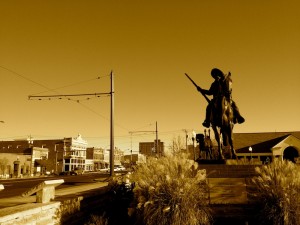
Before I head off back home through what was once Indian Territory and parts of Spain, I pause at the Bass Reeves Monument in downtown Fort Smith. Born a slave to a Texas politician and farmer, Bass Reeves fled to Indian Territory in the 1860s. He was recruited as a federal peace officer for his knowledge of the area. Reeves would go on to become one of the first African Americans commissioned as a federal lawman on the western frontier. I imagine what his life must of entailed, mostly danger and prejudice, I assume. And at the border of Arkansas and the untamed west, where what lay just over the bend was largely a dangerous question mark, I take my boots in that direction. Perhaps with a great deal of true grit, this redheaded stranger and many a traveler can appreciate crossing lines and boundaries into the dangerous unknown.

 Bass Reeves Statue

Have you been to Fort Smith or other once dangerous borders that today sit in their former memories? 

December 6, 2012

Nine Reasons To Go Back to High School in Little Rock
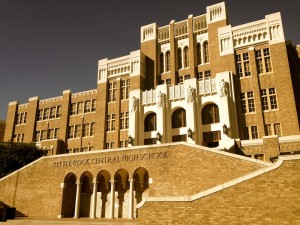
Big yellow school buses perch outside of a high school in Little Rock. The fact that it is a Saturday morning makes them somewhat haunting in their emptiness. I never cared much for high school. Those that did usually didn’t have braces, bad hair and pants that were permanently high-waters. However I never thought of walking into the doors of my high school at 14 years old thinking of that walk was anything but a personal struggle, one that would pass in four years. For nine students in Little Rock, Arkansas that walk into school was the difference between right and wrong, a good society and a bad one, a bright future and dismal present. 

In the fall of 1957, nine African American students marched into the formerly white Central High school in Little Rock. These academic grounds would become a crucial battlefield in the struggle for civil rights. Arkansas Governor Orval Faubus called on the Arkansas National Guard to prevent the nine students from entering the school, a direct order against the U.S. Supreme Court’s desegregation ruling. On September 4, 1957, these teenagers tried to go to school but were turned away. 

For two weeks, these brave souls were not allowed entry into a school that they had every right to attend. Finally, on September 25th, the nine teenagers would get a little help from federal troops. President Dwight D. Eisenhower, the first president since the post Civil War Reconstruction period to use federal troops in support of civil rights, ordered federal troops to Central High School to make certain the rights of the African-American students remained in tact. This act stressed the federal government’s commitment to abolishing separate educational systems based on the color of one’s skin. Documenting this symbolic right of passage, television news crews put this Little Rock high school on the world’s stage. 

The battle would not end there. The nine students would be followed to class by the guards to make certain they weren’t barred from the classroom. They endured abuse to breaking points that lend to expulsion and transfers to other schools and states. The white high school students that befriended the African-American students also faced ridicule over their choice of companionship. Ernest Green would become the first of the Little Rock Nine and the first African American graduate of Central High School. Martin Luther King Jr. even came for the ceremony as a guest of his family. Carlotta Walls, Jefferson Thomas and Thelma Mothershed would also go on to receive their diplomas from Central High School.

 I stand on those steps that launched desegregation in public schools in the United States.  The director of a film crew is barking at me to move out of his shot. Oddly enough, I’m denied entry into Central High School. For a moment, I fester with anger, boil with range. How dare he say I can’t walk around this public space. And then I put my redheaded temperament aside for this denial pales in comparison. 

A man with a giant sound boom motions me to hurry on inside before they start filming again. I run up the steps and duck inside the high school where the roar of a lion greets me. Walking through Central High’s hollowed halls, I feel dread. A high school is generally the last place you want to be on a Saturday or a Tuesday for that matter. This trepidation in the pit of my stomach is tangible. I can hear struggle and achievement with each step. 

I head for the Central High School National Historic Site Visitors Center just up the road from the high school. Exhibits detail the civil rights movement through history, building up to that fateful September in 1957. 

My last stop on this trip back to high school comes on the Arkansas State Capitol Building grounds. Set up on the north side of the Arkansas State Capitol building, Testament is a civil rights memorial to the Little Rock Nine, the work of local artist John Deering. Around this group of students are nine bronze plaques with quotes from Minnijean Brown, Terrance Roberts, Jefferson Thomas, Melba Pattillo, Elizabeth Eckford, Ernest Green, Gloria Ray, Carlotta Walls and Thelma Mothershed, the Little Rock Nine. 

I was never much for high school. I remember the gym classes of horror, lining up to pick teams. I was always picked last or not picked at all. This is my sob story, superficial in comparison to the Little Rock Nine. They had to fight tooth and nail just to go to class. Once they got there, the fight wasn’t over. The abuse wouldn’t end. Gym class was probably just one element to the horror of high school for them. 

I didn’t have troops escorting me to class. I was never denied entry based on the color of my skin. And why I didn’t have to suffer through such atrocities is thanks to what took place on the steps of a Little Rock high school. 

Have you ever visited Central High School in Little Rock?

November 23, 2012

The Meeting of Time, Travel and Money on Back Roads in Arkansas
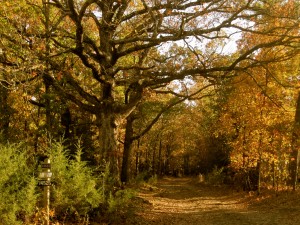
The road on the map is a squiggly line that appears to connect with the Pig Trail Scenic Byway in the Boston Mountains of Arkansas. That darting line of indecision proves to be the rockiest of roads with no cushy marshmallows to break up the bumps. The car stops as the windows roll down. I listen to the chatter of the leaves in the wind. The sound is magically uninterrupted. Time suspends.

Lately I have been struggling with travel, time and money. There never seems to be enough of these three. Travel and time collided for me on a whirlwind trip through Dusseldorf, Copenhagen, Vienna, Zurich and Lucerne at the beginning of the month. Views were only appreciated for brief moments. Feelings weren’t given enough time to grow for each destination. And yet on that back road in Arkansas, I found travel, time and money meeting in their simple, true forms. 

I pass by barns that look like they have seen a few covered wagons roll past. Deer frolic in open fields as they though don’t have a care in the world, despite the fact that hunting season is in full swing down south.


I have nothing but time to get lost down these stretches shaded by bright orange leaves. And with time comes the ability to soak up the travel experience. Each bend in the road, every change in direction is not just a foggy muddled mess in my mind, but rather an experience of fall in Arkansas. I don’t have 5 minutes to enjoy the view or just $5 to spend on the experience. I am penniless and content. 

I have wondered if my ability to merely let travel and time go as they will has something to do with the lack of funds spent on the experience. To traverse the back roads of Arkansas, you don’t necessarily need to be rich in your pockets. A few gallons of gas will see me through this afternoon excursion. There are no hefty plane ticket prices, baggage fees or admission tickets tacked on to this lazy weekend adventure. With no real life worries, I can focus on the task at hand, simply traveling through a corner of the world. 

My simple journey of bumpy back roads meets up with the paved Pig Trail Scenic Byway. It travels through the rugged Boston Mountains of the Ozark Mountains. Around 19 miles, a few other cars travel beneath the tunnel of foliage. 

With the afternoon quickly fading and the evening creeping in, my journey becomes an act of chasing the sun. I pause at an overlook, blanketed in shadows. 

And in chasing the sun, it becomes clear that I am in a metaphorical race. I want to capture this day, this simplistic travel moment under the sunlight. In many respects, I don’t want it to end for I know these days are few and far between, days where time, travel and money meet in their best light, a light you don’t notice until its gone. You don’t need a full bank account to see the world. You just need to see the world in the subtleties of travel.  

Have you ever had a similar travel day, one where time and money seem to fade in significance and you can focus on the travel experience completely?

November 1, 2012

Little Rock, Arkansas Wishes You Were Here
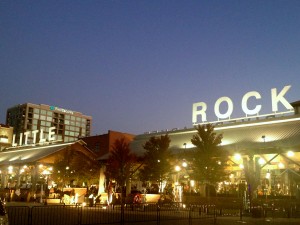
I watch Little Rock from a streetcar window as the trolley chugs through the streets of downtown, a place that lives up to its title. Arkansas’ capital does not boast a dramatic skyline or even a size that overwhelms. It is truly little, but its heart is certainly large.


The River Rail Electric Streetcars in Little Rock are easy to spot. They stun the eyes in their bright yellow coloring. The clickety-click of the tracks make for a rhythmic sound one could fall asleep to while cruising the streets of the downtown. For $1, I ride the Blue Line, a 3.4 mile loop with 15 stops in downtown and across the Arkansas River in North Little Rock. No local would take this mode of transport to get anywhere in a timely manner. These yellow rides are mostly for the tourists. And while it is the tourist thing to do, the streetcars of Little Rock take me back in time. There is something to be said for traveling by way of a replica vintage trolley. 

Little Rock’s roots stem from 1814, but it wouldn’t become the state’s capital until 1836. Set up on the Arkansas River, Little Rock is often called one of America’s most affordable cities. I found that to be true, where you could endlessly ride around town for nothing more than a $1, all while soaking up the details of the city. 

I hope off of my streetcar in search of some Little Rock cuisine. Easily the most buzzing area of the city is the River Market. Home to the Ottenheimer Market Hall, the district bursts with life. I enter the hall and spot brighter yellow leading me to Sweet Soul. Ottenheimer Market Hall is home to around 15 merchants. The international bazaar of food offers a little bit of everything, but I want a taste of the south. 

I order up a catfish po’boy from Sweet Soul, a stand that embraces southern classics. And after a few bites of catfish and sips of sweet tea, I am transported to the south in its tastiest form. 

Just outside the Market Hall, the Saturday Farmers Market takes place. Opened in 1974, you can pick up fresh produce and even handmade arts and crafts. Today a sculpture show occupies part of the space, with some displays proving Little Rock can be tiny or towering above the rest. 

Arkansas’s capital contains a laundry list of Clinton attractions, one of which is the Arkansas Capitol. Bill ruled the city as governor just beyond these six bronze doors on the eastern side. They are the building’s glitzy earrings, bought from Tiffany’s of New York in 1910. 

The Neoclassical design reeks of democracy, almost just like the nation’s Capitol building in miniature. This is Little Rock afterall. I roam the grounds, filled with a rose garden, a Vietnam War Memorial and perhaps the most moving monument to the Little Rock Nine of Central High. When Little’s Rock’s governor tried to stop nine African American students from attending Central High School in 1957, the federal government had to bring in the army to escort the students to class. 

A major civil rights movement and the stomping grounds of one of America’s most well known presidents, Little Rock isn’t small by any means. It is a city whose size might make other capitals laugh. It resides in a state that doesn’t always receive the most attention. And at the same time, Little Rock is colossal. This town provides a taste of the south, where the tea is sweet and the history is great. 

Have you been to Little Rock?

October 25, 2012

Clinton’s Little Rock: A Tour of Arkansas’ Capital Through Presidential Eyes
I pull up a slightly worn seat at a simple table adorned with a red-checkered tablecloth. I can see the kitchen from my perch and probably the big wigs of Arkansas politics. A few patrons wear those goofy bow ties as only some can do. Doe’s Eat Place is the sort of space where people in suits sit on shabby chairs and feast on T-Bone, Porterhouse and Sirloin steaks dressed in fries. 

Doe’s Eat Place is a Little Rock landmark. The idea was carried over from the first Doe’s in Greenville, Mississippi. Doe’s of Little Rock maintained the no frills tradition for good steaks and hot tamales. Over the years, Doe’s would garner celebrity attention when former President Bill Clinton became one of the establishment’s most loyal customers. In fact, Clinton staffers made Doe’s their hangout during the presidential election campaign. 

Photographic memorabilia litters the walls of Does. I order up a T-Bone steak, only to discover that I have ordered for an army. With my massive plate of meat, I receive a marinated salad, potatoes, French fries and Texas Toast. It is no wonder the 42nd president of the United States appreciated Doe’s and its portions. 

The down to earth atmosphere of Doe’s reminds me why people had a soft spot for Bill Clinton. His Arkansas twang reflected a spirit that was never above the next person. Arkansas reflects that modesty, where few venture without some outside purpose such as a business meeting or a family affair. I decided to see what the masses are missing in a place seldom atop bucket lists in Little Rock, a destination were in many respects America’s esteemed former President got his start.

The Residence Inn asked me to test out their Facebook app, the Thrival Guide on my visit to Little Rock. The Thrival Guide is a traveler-generated guide where you can share places to eat and to see depending on where you are staying. You can also find tips and tricks from other travelers of what to see, do and eat in town. I contributed to the guide’s Little Rock section and uncovered in the process a few of Bill’s favorite spots in Arkansas’ capital, beginning with the most important, steaks at Doe’s Eat Place.

I continued my Clinton tour of Little Rock the next morning at the Old State House Museum. The free museum details Arkansas history and politics. You can see a variety of items inside the museum, from Bill’s New Balance sneakers, sunglasses and saxophones to dresses from the First Ladies of Arkansas throughout time and restored legislative chambers. 

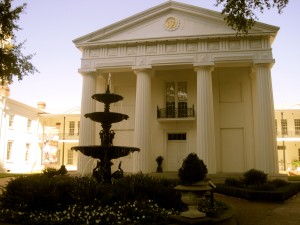
However I can’t keep my eyes off of the building itself. Almost a White House in miniature, the Old State House was built in 1836 and served as the capitol until the government moved into its new digs up the road in 1911. Clinton history is alive and well here. The structure was used as a backdrop for important milestones throughout Bill’s political career. As I admire the grand fountain in front of the structure’s dominate columns, I imagine the moments in recent U.S. history that took place in a space few even visit. Clinton announced his candidacy for president on these steps. He celebrated his election victory here in 1992 and his reelection in 1996. 

Bill has even called this his favorite building in all of Arkansas and frankly I might agree. He believed it embodied the reverence for the past and yet the home for the future. Its history reflects that for this space was just a wilderness on the edge of the American frontier. The people of Little Rock decided to construct a grand edifice that would translate the glory and democracy of ancient Greece to house their new government. The Old State House proves there is more than just one White House in this nation.

My stomach begins to grumble again. Being on the Clinton Little Rock diet expands stomachs even on a 24 hour visit. I head to the Community Bakery in downtown Little Rock, an institution in central Arkansas for over 60 years. It is where Bill would grab a coffee and bagel on his morning jog as Governor. Instead I grab a cherry Danish and coffee and appreciate the Saturday morning sea of activity taking place before me. 

I close out the Clinton tour at the William J. Clinton Presidential Center, home to America’s newest Presidential Library. The archival collection is the largest in American presidential history. The center chronicles U.S. history at the turn of the 21st century, juxtaposed with the Clinton years. 

Within the center, I appreciate the chance to sit in the President’s seat at the replica White House Cabinet Room. I pop in the full-scale replica of the Oval Office and admire the many gifts the president received, from Mickey Mantle baseball cards to one of Lance Armstrong’s now controversial yellow jerseys. 

The life and work of America’s 42nd president carries throughout the center and Little Rock for that matter. My last Clinton exchange takes me to the temporary exhibit on site detailing both Hilary and Bill’s mothers. The 19th Amendment casually sits in this section on loan. And with an election just week’s away, the piece of paper before me, in Little Rock of all places, tells why I can vote.

At times, Little Rock can seem just that, an insignificant stop, seldom a destination for world travelers. However buried under this little rock is a sea of American history, of Clinton haunts and hideouts. Clinton recently said in a speech at the Democratic Convention, “I was just a country boy from Arkansas and I came from a place where people still thought two and two was four.” Arkansas and its capital might be simple and simply off a traveler’s radar but a visit here is a taste of a leader, speaker and a man who brought the Arkansas ideals for humility into the national spotlight. 

Full Disclosure: I received a complimentary night at a Residence Inn in Little Rock and a gift card to find places to add to the Thrival Guide Facebook App. However my thoughts and opinions are always my own. 

November 30, 2011

A Year in Travel

It is the eve of the last month of the year. December is a month I seldom travel. It is a month designated for family time. Each weekend seems to spur an event or occasion. It is also the final chapter of the year, a time for reflection.

And on the eve of the last month of 2011, I couldn’t help but think back on my travels for the year, as many of us do throughout this time of ending and beginning. What I have concluded about my travels this year is that I learned something about travel I didn’t realize before. The realization comes after travel, when you are home reflecting on experiences. Travel should make you wonder how you did this, how you got through that. It is almost mystical in a sense, a hazy memory in the past. Questioning its reality only makes it that much more special.

Last Minute Travel

When an opportunity presents itself, especially in regards to travel, I have learned you have to seize it. Invited on a press trip to Mexico, really by chance and not so much by choice, I found myself jetting off to Ixtapa without knowing what I was doing here. As the snow fell in Colorado, I dug out all of my summer clothes and headed south of the border. I watchedcoconut candy the color of a highlighter set being made in a modest village. I wandered through markets in Zihuatanejo and observed the close proximity of freshly cut meat to children’s toys. I arrived at the miraculous in Petatlán, a statue to Jesus adorned in lime green.

Before this year, I had never taken such a chance on travel in such short notice. I know many would not turn down this opportunity unless they had a commitment they couldn’t get out of or an obligation to meet. Luckily for me, my office can move with me. Mexico opened my eyes to the brightest of colors and the remarkable sheen to traveling last minute. You don’t have time to think about what you are doing, if it’s right or wrong. In essence, travel worry time is eliminated. You go into the experience wide eyed and leave that way. There is no time to prepare for what you will see and that might be travel’s best gift. A lack of preparation gives you the rawest view of your destination, the most unaltered and unbiased perspective.


Solo Travel


After braving it in Mexico for several days, without knowing a soul, I think I was even more prepared to head to Ireland all by my lonesome. As I have mentioned before, I was a bit of a solo travel fraud. I had made the occasional trip by myself, but I had never set out to do something completely alone, without visitors or friends joining me along the way. In March, I left for Ireland to drive on the wrong side of the road and discover what it means to travel solo. I talked to strangers and sheep, on more occasions than I anticipated. I discovered Irish humility with every turn of the bend. I was robbed for the first time abroad.


I can’t say solo travel is for everyone and I can’t say it is completely for me. However until you take one trip alone, no matter how big or small, you can’t completely know yourself. At least that’s what I learned. A few week’s ago I said to a friend, “I can’t believe I did that, drive around Ireland for a month all alone.” It is the unbelievability of travel I don’t think I had seen before. Solo travel is a great way to bring this about in yourself. You are forced to recognize yourself with a new-found confidence. It becomes unbelievable once you return home and all the more powerful you came, you saw and you conquered, solo.

Travel In One’s Own Country


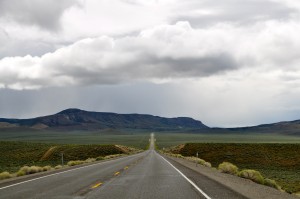
This year, I traveled my country. So often you hear Americans don’t travel, they lack passports and culture. What is seldom brought up in those articles is that the United States is massive. This year, I found myself nearly traveling from the Pacific Coast to the Atlantic. A wedding out in California spurred a road trip across Colorado, Wyoming, Utah, Nevada and California. I found the loneliest highway in America and appreciated the lack of activity. Loneliness can be good for you. I returned home, only to plot another road trip, this time across America’s South. Beginning in Arkansas, I made my way across Tennessee, North Carolina, down through South Carolina and Georgia and up through Alabama and Mississippi. I spent a weekend in New York City, revisiting a city so unique and overwhelming.


The two road trips were different, but their meanings were the same. I set out to get to know parts of my own country I traveled mostly on family road trips as a terrible toddler. I wanted to get to know where I am from on levels many don’t deem worthy these days. Glamorous and fulfilling travel doesn’t have to be off in Moscow or on the streets of Paris. It can be in one’s own country, a notion I picked up this year.


Next year no doubt will bring new realizations, new appreciations of why I travel. I don’t know where I am going, how I am getting there or whom I will go with, but I know I will go.

What have your learned about travel in 2011?